Owing to the screen size of your device, you may obtain a better viewing experience by
rotating your device a quarter-turn (to get the so-called "panorama" screen view).
|
This page updated for 2022.
|
Click here for the site directory.
|
|
Please consider linking to this site!
|
Click here to email us.
|
Coriander
(Coriandrum sativum)
We believe, for the reasons set forth on the main Herbs directory page, that growing spice plants for seed is not wise gardening; but, for those who disagree, the information here should suffice.
About Coriander
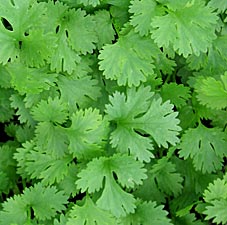
Coriander is, in a sense, two flavoring plants. One, used for its leaf, is commonly known as cilantro, and has in recent years become commonplace if not indeed famous; we (or at least one of us), like many, many others past and present, think it repugnant. (Its very name is from a Greek word for “bug” and is commonly associated with bedbugs, whose smell is reputed to closely resemble cilantro—or, more to the point, vice versa; “fetid” and “soapy” are other words commonly used for its smell and taste).
(It seems that there is a genetic element in one’s liking for or disliking of cilantro (see A genetic variant near olfactory receptor genes influences cilantro preference). That explains the stupendous gap between those who adore the stuff and those who can scarcely find words for their detestation.)
But, used for its “seed” (not truly seed but actually the fruit of the plant), and known as “coriander seed”, it is a very different thing. The quite aromatic “seed” has a taste often described as sweet and vaguely orange-ish. It is an essential ingredient of virtually all curry powders, and is widely used in the cuisines of the Middle East; any good cook will find numerous uses for it.
Cultivars
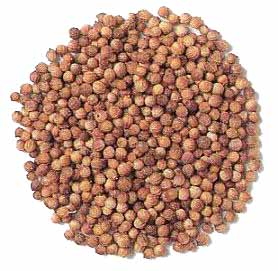
For all that drastic difference between the leaf use and the “seed” use, the plant is the same thing: only the parts used vary. Still, today, with the sudden popularity of cilantro (owing, no doubt, to its heavy use in certain ethnic cuisines now developing followings in mainstream America), varieties have been developed especially to be “slow-bolting”, for the notorious habit of coriander of easily bolting to seed, handy for those who want it for its “seed”, is a big drawback to those who want cilantro.
Because we want it for its “seed”, we need to look out for varieties that are not labelled as “slow bolting” or, better yet, that are identified as “for seed”. There seem to be at least two main types—the large-seeded Indian and the smaller-seeded European—but no seed catalogues we have seen carry cultivars by name. The best one can do is to avoid any type labelled “slow-bolting”.
Planting
Timing
The plant can take up to 4 months from seeding to harvest, and likes warm growing weather. The usual broad planting advice is “spring” or “ealy spring”; in Saskatchewan, the advice is “mid-April to mid-May”, while in Britain it is April. Around here, May 1st looks like a good time, as growth will run through August, capturing our warmest months (coriander can withstand light frosts, which we can get into early June). Warmth is a problem for cilantro growers, because it pushes the plant into bolting, but when grown for seed, that is just what is wanted.
The Bed
The general rule for herb and spice plants is that their soil needs are not demanding, save that the soil must be very well-drained: few herb or spice plants can stand “wet feet”. The soil should not be particularly rich, most especially not for flavoring plants we grow for their seed (or fruit), common mis-advice to the contrary notwithstanding: a rich soil will lower the concentration of the “aromatic oils” that give the seed its characteristic flavor, which is the very thing we are growing them for. Plants that are slightly nutrient-stressed (which doesn’t mean starved) give better-tasting seed.
Coriander is typical of the remarks above, save that when grown for its “seed” it actually seems to benefit from a little shade (as, for example, behind taller plants). Also, because it does not compete well with weeds (especially perennial weeds) be sure to plant it in a well-cleared bed.
Planting Out
Gently crack the “seeds” before planting—putting them in a small plastic bag and gently applying a rolling pin should crack open the husks. The “seed” of coriander is not true seed but a fruit, each fruit having two embryos inside; you can plant each of the two as a “seed”, so reckon on two plants per husk (if you get 100% germination).
Sow the “seeds” about ¼ to ½ inch deep where the plants are to grow (like many herb and spice plants, coriander does not take well to transplanting). The plants can be spaced quite close together, say at 4 inches (commercial growers sometimes seed at several to the inch).
Coriander typically germinates very slowly: it can easily take as long as 3 weeks to emerge, so don’t get frustrated too soon. Just keep it well watered.
Growing
Coriander cannot handle dry soil: as noted above, keep it well watered.
The availability of honey bees as pollinators will usually improve coriander yields.
Coriander “seeds” notoriously ripen unevenly, so you need to keep a close eye on your crop and harvest plants individually, lest the heads shatter prematurely. Let each plant grow till its first set of seeds dries enough to crack when pinched (it can take up to 120 days to produce mature seed, depending in part on cultivar); at that time, cut the plant. Hang cut plants to dry over a catch-cloth; when they are thoroughly dry, dump them into a holding bag (which you will later use for threshing them).
When your crop is fully harvested, thresh the lot: beat the holding bag in which you have collected them against a hard surface to dislodge the seeds. Sift the loose seeds through a 3-inch mesh hardware cloth to remove the chaff. Make absolutely, positively sure the seeds are thoroughly dried before putting them away for storage (in the usual manner for dried herbs and spices: an airtight container stored in a dark place, preferably a cool one).
Relevant Links
Besides any links presented above on this page, the following ought to be especially helpful.
Return to the top of this page.
If you find this site interesting or useful, please link to it on your site by cutting and pasting this HTML:
The <a href="https://growingtaste.com/"><b>Growing Taste</b></a> Vegetable-Gardening Site
—Site Directory—
Search this site, or the web
-
Background Information
about the purposes and design of this site
- Site Front Page
-
Introduction
- An Apologia: why one should cultivate one's garden
- Deep-Bed Gardening (forthcoming)
- Container Gardening (forthcoming)
- Vegetarian and Organic Considerations (forthcoming)
-
Recommended Crops for a home garden, by variety
-
Gardening information and aids
-
Miscellaneous Information of interest to the home gardener
Since you're growing your own vegetables and fruits, shouldn't you be cooking them in the best way possible?
Visit The Induction Site to find out what that best way is!
|
If you like good-tasting food, perhaps you are interested in good-tasting wines as well?
Visit That Useful Wine Site for advice and recommendations for both novices and experts.
|

|
This site is one of The Owlcroft Company family of web sites. Please click on the link (or the owl)
to see a menu of our other diverse user-friendly, helpful sites.
|
|
 Like all our sites, this one is hosted at the highly regarded Pair Networks,
whom we strongly recommend. We invite you to click on the Pair link for more information on getting your site or sites hosted on a first-class service.
Like all our sites, this one is hosted at the highly regarded Pair Networks,
whom we strongly recommend. We invite you to click on the Pair link for more information on getting your site or sites hosted on a first-class service.
|
|
All Owlcroft systems run on Ubuntu Linux and we heartily recommend it to everyone—click on the link for more information.
|
Click here to send us email.
Because we believe in inter-operability, we have taken the trouble to assure that
this web page is 100% compliant with the World Wide Web Consortium's
XHTML Protocol v1.0 (Transitional).
You can click on the logo below to test this page!
You loaded this page on
Tuesday, 16 April 2024, at 04:38 EDT.
It was last modified on Sunday, 9 January 2022, at 19:04 EST.
All content copyright ©1999 - 2024 by
The Owlcroft Company