Owing to the screen size of your device, you may obtain a better viewing experience by
rotating your device a quarter-turn (to get the so-called "panorama" screen view).
|
This page updated for 2022.
|
Click here for the site directory.
|
|
Please consider linking to this site!
|
Click here to email us.
|
Dill Weed
(Anethum graveolens)
About Dill Weed
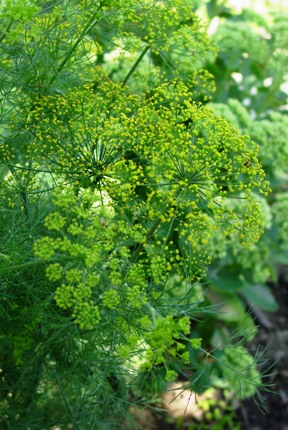
Dill is, we think, one of the great herbs, and is sadly underappreciated and underused in the U.S. Dill is grown for both its dried seeds and its ferny leaf; though the same plant can be used for both purposes, cultivars aimed at one or the other particular use have been bred, so one is best off using different plants, of different cultivars, for the two purposes. This page deals only with growing dill for leaf (commonly called “dill weed").
Cultivars
Dill cultivars (like those of coriander) fall into two broad classes, those intended mainly for seed production and “slow-bolt“ types intended mainly for leaf production; there are also some varieties that are distinctly smaller than the others, intended especially for container growing. If one has restricted indoor growing space and needs a small container-suitable dill for leaf growth, the cultivar “Fernleaf” used to be (and for many still is) the standard choice. But a relatively new variety, Teddy, now seems the better choice, being (by report) “faster growing and more productive than Fernleaf”.
For those who are growing dill weed outdoors, there are numerous choices, each with its partisans. The variety Dukat seems more frequently than others described as being “strongly flavored”, which would is, after all, the desideratum; it’s not a runaway, but we would choose it if growing outdoors. (Note that the type “SuperDukat“ is a hybrid—hybrid herbs, ugh, Just Say No.)
Planting
Dill is an annual. In its early growth, which typically lasts 40 to 60 days after emergence, it produces the ferny leaves (“weed“) that we want. At some point, the plant starts sending up a flower stalk from its center, at which time leaf production ceases (and seed production begins). Obviously, then, we need to start a new plant every couple of months or so to be assured of a continuing supply of fresh dill weed.
As with most herbs, dill definitely wants well-drained soil. It likes full sun.
To sow, place the seed on the soil surface, then just barely cover it with sifted soil or a little sand. After sowing, be patient, for dill is a slow germinator, often taking over 3 weeks to emerge, though rather less if the soil is warm (as it should be indoors).
Note well that if you want to grow dill in a container, you must use a deep one—12 inches is about the minimum, and more (say 18" or even 24") is better. (Dill has a long tap root).
Growing
Fertilize growing dill when the plants start flowering with a sprinkling of fertilizer high in potassium and phosphorus.
Keep an eye on your dill plants—which, of the non-dwarf varieties, can get tall, 2 to 3 feet high if healthy—to see if they’re starting to droop from being top-heavy; if so, stake them.
Relevant Links
Besides any links presented above on this page, the following ought to be especially helpful.
Return to the top of this page.
If you find this site interesting or useful, please link to it on your site by cutting and pasting this HTML:
The <a href="https://growingtaste.com/"><b>Growing Taste</b></a> Vegetable-Gardening Site
—Site Directory—
Search this site, or the web
-
Background Information
about the purposes and design of this site
- Site Front Page
-
Introduction
- An Apologia: why one should cultivate one's garden
- Deep-Bed Gardening (forthcoming)
- Container Gardening (forthcoming)
- Vegetarian and Organic Considerations (forthcoming)
-
Recommended Crops for a home garden, by variety
-
Gardening information and aids
-
Miscellaneous Information of interest to the home gardener
Since you're growing your own vegetables and fruits, shouldn't you be cooking them in the best way possible?
Visit The Induction Site to find out what that best way is!
|
If you like good-tasting food, perhaps you are interested in good-tasting wines as well?
Visit That Useful Wine Site for advice and recommendations for both novices and experts.
|

|
This site is one of The Owlcroft Company family of web sites. Please click on the link (or the owl)
to see a menu of our other diverse user-friendly, helpful sites.
|
|
 Like all our sites, this one is hosted at the highly regarded Pair Networks,
whom we strongly recommend. We invite you to click on the Pair link for more information on getting your site or sites hosted on a first-class service.
Like all our sites, this one is hosted at the highly regarded Pair Networks,
whom we strongly recommend. We invite you to click on the Pair link for more information on getting your site or sites hosted on a first-class service.
|
|
All Owlcroft systems run on Ubuntu Linux and we heartily recommend it to everyone—click on the link for more information.
|
Click here to send us email.
Because we believe in inter-operability, we have taken the trouble to assure that
this web page is 100% compliant with the World Wide Web Consortium's
XHTML Protocol v1.0 (Transitional).
You can click on the logo below to test this page!
You loaded this page on
Thursday, 25 April 2024, at 15:22 EDT.
It was last modified on Sunday, 9 January 2022, at 21:00 EST.
All content copyright ©1999 - 2024 by
The Owlcroft Company