Owing to the screen size of your device, you may obtain a better viewing experience by
rotating your device a quarter-turn (to get the so-called "panorama" screen view).
|
This page updated for 2022.
|
Click here for the site directory.
|
|
Please consider linking to this site!
|
Click here to email us.
|
Rosemary
(Salvia rosmarinus)
(formerly Rosmarinus officinalis)
About Rosemary
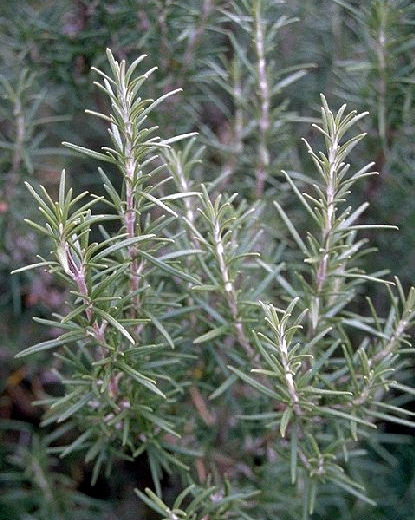
This powerfully flavored evergreen perennial—indispensible in the sound kitchen—is widely grown for not only culinary but also decorative purposes. If it’s happy in its home, a rosemary plant can last a quarter to a third of a century.
Cultivars
Perennializing rosemary outdoors was an unlikely business hereabout till recent years, when a few hardier cultivars, supposedly hardy to Zone 6, showed up; but even “hardy to Zone 6” (or, as one or two claim, to Zone 5) still leaves them marginal here for overwintering.
But though rosemary is seldom wanted in quantity, it is wanted often, making indoors growing desireable; moreover, growing it indoors works exceeding well. And if we’re growing it indoors, winter-hardiness is not a concern.
Rosemary comes in numerous variants: one source remarks that they themselves have 63 varieties in their garden collection. Perhaps regrettably, most cultivar discussions these days focus on winter hardiness, appearance, and growth habit rather than culinary quality. One source did remark that “Chefs generally agree that the more silvery the undersides of the needles, the better a rosemary cultivar will be for cooking”; that’s interesting, but, absent a large number of cultivars displayed for our examination, not terribly helpful in a practical sense.
Most herb specialists purvey numerous rosemarys, and most also will say of one or another that it is their personal culinary favorite; sad to say, there is little if any consistency in these recommendations—indeed, many, perhaps most, of the recommended types seem to be more or less proprietary to the vendor. It’s clear that there really are significant difference from one to another cultivar—while they’ll all be strong enough, there is the matter of the balance of the various “essential oils” that give the characteristic taste—but it seems to be as much a matter of picking your supplier as of picking your cultivar.
After assembling and reviewing a great number of apparently expert comments from around the web, it looks like there are several pretty good types, but the clear drift seems to be toward the type Tuscan
Blue.
Planting
Rosemary can be seed-grown—though not easily—but it’s a perennial and we are best off buying good cuttings from, as we have said, reliable specialist seedsmen.
As with many herbs, rosemary produces best flavor on the sorts of poor, relatively barren soils that reproduce its native habitat; it is not fussy, but a slightly alkaline soil is best. Though given the chance it will luxuriate, we can keep it in a relatively small pot, as we want it continually but rarely in much quantity at any one time. It does, however, like most herbs, want very well-drained soil—indeed, moisture control is especially crucial with rosemary (see the discussion farther below).
Like most Mediterranean herbs, rosemary needs full sun.
Grown indoors, rosemary occasionally suffers from powdery mildew. If your rosemary goes off from it, Safer’s makes a product called “Defender” said to cure the ailment literally within hours. Another option is a homebrew of 2 T. baking soda and 2 T. summer oil in 1 gallon of water, sprayed every 7 to 10 days (a recipe from Mulberry Creek Herbs that we simply pass on with no knowledge of its effectiveness).
Growing
Watering rosemary properly is the only aspect of growing it requiring much attention. Rosemary can be easily killed off either by being allowed to completely dry out or by being given “wet feet” (excessive root moisture). So water regularly but sparingly, and pay attention to the soil moisture. And do not, as some sources casually recommend, mist the plant.
Keep rosemary well pruned—it withstands pruning excellently, and is often used as a topiary subject. (Try, though, to avoid cutting older wood.)
Note: if you’re not a veteran rosemary user, begin with caution. While it is a necessary ingredient in many types of cookery, it needs to be added with a light hand, being very powerfully flavored. Better too little than too much till you acquire a sure feeling for its use.
(You can use rosemary branches as kebab skewers, in which use they add a subtle rosemary note; find the longest sprigs and strip off all leaves from the stem except for those at the growing tip, or—better—just don’t lop off denuded branches as you take needles for ordinary use, so you have a supply of “skewers”.)
Relevant Links
Besides any links presented above on this page, the following ought to be especially helpful.
Return to the top of this page.
If you find this site interesting or useful, please link to it on your site by cutting and pasting this HTML:
The <a href="https://growingtaste.com/"><b>Growing Taste</b></a> Vegetable-Gardening Site
—Site Directory—
Search this site, or the web
-
Background Information
about the purposes and design of this site
- Site Front Page
-
Introduction

- An Apologia: why one should cultivate one's garden
- Deep-Bed Gardening (forthcoming)
- Container Gardening (forthcoming)
- Vegetarian and Organic Considerations (forthcoming)
-
Recommended Crops for a home garden, by variety
-
Gardening information and aids
-
Miscellaneous Information of interest to the home gardener
Since you're growing your own vegetables and fruits, shouldn't you be cooking them in the best way possible?
Visit The Induction Site to find out what that best way is!
|
If you like good-tasting food, perhaps you are interested in good-tasting wines as well?
Visit That Useful Wine Site for advice and recommendations for both novices and experts.
|

|
This site is one of The Owlcroft Company family of web sites. Please click on the link (or the owl)
to see a menu of our other diverse user-friendly, helpful sites.
|
|
 Like all our sites, this one is hosted at the highly regarded Pair Networks,
whom we strongly recommend. We invite you to click on the Pair link for more information on getting your site or sites hosted on a first-class service.
Like all our sites, this one is hosted at the highly regarded Pair Networks,
whom we strongly recommend. We invite you to click on the Pair link for more information on getting your site or sites hosted on a first-class service.
|
|
All Owlcroft systems run on Ubuntu Linux and we heartily recommend it to everyone—click on the link for more information.
|
Click here to send us email.
Because we believe in inter-operability, we have taken the trouble to assure that
this web page is 100% compliant with the World Wide Web Consortium's
XHTML Protocol v1.0 (Transitional).
You can click on the logo below to test this page!
You loaded this page on
Wednesday, 17 April 2024, at 08:11 EDT.
It was last modified on Monday, 10 January 2022, at 18:38 EST.
All content copyright ©1999 - 2024 by
The Owlcroft Company