Owing to the screen size of your device, you may obtain a better viewing experience by
rotating your device a quarter-turn (to get the so-called "panorama" screen view).
|
This page updated for 2022.
|
Click here for the site directory.
|
|
Please consider linking to this site!
|
Click here to email us.
|
Sesame
(Sesamum indicum)
We believe, for the reasons set forth on the main Herbs directory page, that growing spice plants for seed is not wise gardening; but, for those who disagree, the information here should suffice.
About Sesame
Sesame seed is a huge commercial crop owing to the valuable multi-use oil extracted from it, but its culinary use is as a flavoring, always lightly toasted (untoasted sesame seed has little taste). It has a deal more flavor than its silly use on hamburger buns would indicate, and in many regions is an important element of the cookery. (The oil expressed from sesame seeds is also a valued culinary product.)
Cultivars
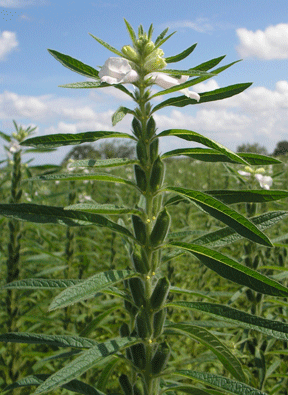
There are literally thousands of named cultivars of this plant in worldwide commercial use, but we could find none at all in domestic home-garden seed catalogues (Nichols carries a seed sesame that they call “Benne”, but that is just an old alternative generic name for sesame). That is even more of a shame than is usual with spice and herb plants, because the many cultivars have significantly different uses and advantages. Even the crude separation into “white sesame” and “black sesame” is of little assistance, because though they’re different types, the color results from how they have been processed.
For example, sesame is short-day plant, whose flowering is initiated by daylength shortening till it reaches a critical level; thus, many sesame cultivars have been developed each for use at a particular range of latitude. But apparently we home gardeners have to take it on trust that the generic “sesame” we get from our seedsmen is suited to the whole of the U.S. (This is thus one plant for which it makes especial sense to get it from a seed source—that grows its own or gets it regionally—at one’s own approximate latitude.)
Moreover, since Sesame wants a long, warm growing season (it cannot tolerate frost), a fast-growing variety—like “90 Day” (a University of California release)—would be nice in our region: but, again, no choices.
Finally, since “shattering” (cracking open of the seed capsule prior to intended harvest) is a problem with sesame as it is with many spice-seed plants, cultivars that minimize shattering are important to the commercial trade, and there have been such “no-shatter” cultivars for almost half a century now. But, again, no choices. And we suppose that things will continue in this way till home gardeners get interested enough to demand that their seedsmen identify cultivars on all their seeds and plants.
Planting
Timing
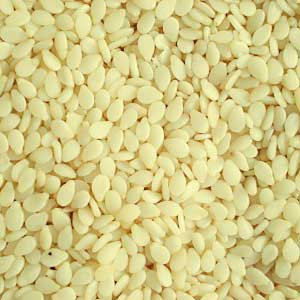
Because sesame wants a long, warm season, in our climate one is probably best off sowing it (direct where it is to grow) in mid-May or even around June 1st. The minimum soil temperature for satisfactory germination is 60° F., and higher is better—it should be treated more or less like a bean, even a lima bean.
The Bed
The general rule for herb and spice plants is that their soil needs are not demanding, save that the soil must be very well-drained: few herb or spice plants can stand “wet feet”. The soil should not be particularly rich, most especially not for flavoring plants we grow for their seed (or fruit), common mis-advice to the contrary notwithstanding: a rich soil will lower the concentration of the “aromatic oils” that give the seed its characteristic flavor, which is the very thing we are growing them for. Plants that are slightly nutrient-stressed (which doesn’t mean starved) give better-tasting seed.
Sesame fits that model, save that it is just a little pickier about its soil pH, wanting soil in the range of 5.4 to 6.7—it is intolerant of very acidic or saline soils. Good drainage, always wanted with spices and herbs, is even more important with sesame, as it is quite susceptible to harm from even short periods of waterlogging.
Planting Out
Sow seed in moist but not soaked soil. Sesame seed is quite small, so plant it fairly shallow, around ½" deep. Ideal spacing is unclear, but 6 inches is certainly enough; significantly less is probably feasible (commercial row-crop stands are planted at 1 to 2 inches separation).
Growing
As with most spices, water only lightly, so as to concentrate the essential flavoring oils in the seed.
Harvest when the seed capsules have mostly or entirely turned brown, then dry the seeds well before, and then again after, threshing. Since the capsules are prone to shattering, it is probably a good idea to enclose them, as harvest approaches, in permeable “mini-sacks” of cheesecloth or the like (or perhaps old row cover bits) to catch seeds released by premature shattering.
Relevant Links
Besides any links presented above on this page, the following ought to be especially helpful.
Return to the top of this page.
If you find this site interesting or useful, please link to it on your site by cutting and pasting this HTML:
The <a href="https://growingtaste.com/"><b>Growing Taste</b></a> Vegetable-Gardening Site
—Site Directory—
Search this site, or the web
-
Background Information
about the purposes and design of this site
- Site Front Page
-
Introduction
- An Apologia: why one should cultivate one's garden
- Deep-Bed Gardening (forthcoming)
- Container Gardening (forthcoming)
- Vegetarian and Organic Considerations (forthcoming)
-
Recommended Crops for a home garden, by variety
-
Gardening information and aids
-
Miscellaneous Information of interest to the home gardener
Since you're growing your own vegetables and fruits, shouldn't you be cooking them in the best way possible?
Visit The Induction Site to find out what that best way is!
|
If you like good-tasting food, perhaps you are interested in good-tasting wines as well?
Visit That Useful Wine Site for advice and recommendations for both novices and experts.
|

|
This site is one of The Owlcroft Company family of web sites. Please click on the link (or the owl)
to see a menu of our other diverse user-friendly, helpful sites.
|
|
 Like all our sites, this one is hosted at the highly regarded Pair Networks,
whom we strongly recommend. We invite you to click on the Pair link for more information on getting your site or sites hosted on a first-class service.
Like all our sites, this one is hosted at the highly regarded Pair Networks,
whom we strongly recommend. We invite you to click on the Pair link for more information on getting your site or sites hosted on a first-class service.
|
|
All Owlcroft systems run on Ubuntu Linux and we heartily recommend it to everyone—click on the link for more information.
|
Click here to send us email.
Because we believe in inter-operability, we have taken the trouble to assure that
this web page is 100% compliant with the World Wide Web Consortium's
XHTML Protocol v1.0 (Transitional).
You can click on the logo below to test this page!
You loaded this page on
Saturday, 20 April 2024, at 03:05 EDT.
It was last modified on Monday, 10 January 2022, at 20:39 EST.
All content copyright ©1999 - 2024 by
The Owlcroft Company