Owing to the screen size of your device, you may obtain a better viewing experience by
rotating your device a quarter-turn (to get the so-called "panorama" screen view).
|
This page updated for 2022.
|
Click here for the site directory.
|
|
Please consider linking to this site!
|
Click here to email us.
|
Kohlrabi
(Brassica oleracea gongylodes)
Cultivars
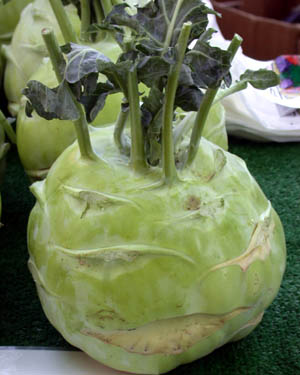
Kohlrabi seemingly is not much grown in this country, despite a Continental popularity. One of the hindering factors appears to be the urgent need—with most varieties—to make sure and pick it when still quite small, maybe 2 inches’ diameter maximum, lest it get quite unpleasantly woody and even bitter. A great vegetable might justify the need for such prissy attention, but we suspect that its best friends wouldn’t call kohlrabi a great vegetable.
Mind, if kohlrabi is not a “great” vegetable, it is still an awfully good one. It seems to command little respect in the literature, but we think it the second-best of all the numerous Brassicas, behind only well-grown broccoli. Though some describe it as somewhat pungent (as most Brassicas are), we found it—at least the cultivar we grew—to be rather mild: in fact, a great way to get the characteristic Brassica taste with no sting or bitterness (unlike, say, a turnip).
Fortunately there is a variety of kohlrabi that can, and does, achieve great size without losing any quality; that, obviously, is the type we trialled and now stick with. It is most commonly called Gigante, but is also known as Superschmeltz. The ones we grew got substantially bigger than a softball, yet were pleasantly mild, sweet, and good-textured. (It is said that ten-pound, bowling-ball-sized specimens are not rare.) We suspect that those who report kohlrabi to be pungent have been dealing with oversize non-Gigante specimens (about all you’ll get in retail groceries and supermarkets), since few commercial farmers will pick at 2" a vegetable that can be grown to 4" or 5"; that’s another reason why the Gigante cultivar is so great.
We previously wrote here “We hope that we end up liking it and growing it every year, just because of how much fun it would be to shout out ‘Hey, dear, let’s have some superschmeltz tonight!’” Well, by gum, we do like it, and yes, by gum, it is fun to say that! (It goes well with all sorts of sauces, but a dill/sour-cream one is especially heavenly.)
This is a seriously under-valued and under-used vegetable; it can (and for us and, it seems, many others) utterly displace turnips and rutabagas, but that’s somewhat left-handed praise that fails to do it proper justice.
(Note also that many people find kohlrabi leaves an excellent potherb, somewhat like turnip greens.)
Planting
Timing
Most or all commercial kohlrabi is direct-seeded, and there’s no reason not to follow suit in the home garden. Mature kohlrabi withstand even severe frosts—indeed, the plant can be left in the ground right through winter—but young plants may bolt if they see, say, a week of temperatures at or below 50°F. (daily highs, that is). Once started, kohlrabi is said to grow best at a temperature between 65° and 75° F. Typical growth times are 7 to 8 weeks, but the Superschmeltz/Gigante cultivar can go as long as 4 months or more in reaching its full development (one northern seedsman actually says 130 days, though another source says “only” 80 days).
If we do our reckoning by examining the earliest time we could plant, the concern is to not be so early that the seedlings might see cool daytime temperatures and bolt. Daily highs hereabouts do not—as always, on average—rise above 50° till late March; even being extra-cautious, then, planting around April 1st should be fine. Even the Superschmeltz/Gigante cultivar, were it planted at that time, would be ready by no later than early to at latest middle August. But that raises a problem: Kohlrabi, like many “roots” (though it is not, technically, a “root” crop—the bulb is an enlarged stem), becomes better-tasting after at least one light frost. We don’t get frosts in August, but Gigante, once i finishes growing, can survive frosts; thus, we can leave it in the ground till we’ve had a few of those sweetening frosts—indeed till the ground is at risk of freezing such that digging the ball out is difficult.
Starting Seed
Sow seed ¼ to ½ inch deep. Jeavons recommends a 4-inch spacing, but he obviously wasn’t dealing with Superschmeltz. We would say 6 inches absolute minimum, and more if your space allows it, up to 10 or 12 or even 16 inches, to accomodate the large size they can attain.
The Bed
Kohlrabi likes much the same conditions as all cole crops: it’s fairly indifferent to soil type and pH, but does like well-drained soil; some sources say they prefer a slightly alkaline soil, a hair over 7.0. They are also said to prefer a “heavy” soil, so—within reasonable bounds—clay is not a problem. But unlike most coles, Kohlrabi is said to like a little shade when growing (in a deep bed, the plant spacing will cause the leaves to act as a shade canopy over the plants—the proverbial “living mulch” effect—so that’s OK). They are heavy feeders, and want well-fertilized soil.
Growing
Established plants are drought-tolerant, but the best stems are formed when the plant does not go short of moisture.
You actually can harvest as early as you like, but with the Superschmeltz type (which doesn’t go all coarse and woody with size) you can, in the fall, just let it go and go till it gets as big as it will, then—because they are so frost-hardy—leave it there till you’re ready for it. (Though the ground might freeze, making harvest more difficult—but the kohlrabi, the part we want being really a swollen stem, is actually almost entirely above ground.) We, in our then-ignorance, once planted them way too early—around June 1st, and they got hit by The Great Freeze that year—but we still got magnificent specimens from all our plants. This is one generous vegetable.
More
Relevant Links
Besides any links presented above on this page, the following ought to be especially helpful:
Odds and Ends
Biology
Kohlrabi’s name (think “cole”, as in “cole slaw”, and “raab” as in “broccoli raab”) tells its tale: it’s another of the productive, tasty, and nutritious members of the Cruciferae family, the crucifers.
Unlike most of them, however, it is grown for its swollen stem (though often called one, it is not a “root” vegetable).
History
Kohlrabi’s true origin is unclear, but it was already known by the 1st century A.D., for Pliny the Elder mentions a “Corinthian turnip”, which—from its described growing habits—is almost certainly kohlrabi. Apicius, who wrote the oldest known cookbook on cooking and dining in imperial Rome, also mentions the vegetable in his recipes.
Charlemagne, Emperor of the Holy Roman Empire from 800 A.D., ordered kohlrabi grown in all the lands under his reign; one thinks of Charlemagne as French, but his city of residence, then called Aix-la-Chapelle, is now Aachen, which is in the Western portion of Germany—hence kohlrabi’s German name, which means “cabbage turnip” (Charlemagne was better known in his time as Karl des Grosses).
Kohlrabi found its way into Northern India in the 1600s, where it soon became a dietary staple. More recently, kohlrabi has become an established vegetable in China and Africa.
In America, the vegetable remains sadly neglected; only in the South does it enjoy even a modicum of popularity.
Envoi
Now that the town of Kohlrabi, California no longer exists [archived copy], you might want to look in at this page about The Order of the Kohlrabi.
Return to the top of this page.
If you find this site interesting or useful, please link to it on your site by cutting and pasting this HTML:
The <a href="https://growingtaste.com/"><b>Growing Taste</b></a> Vegetable-Gardening Site
—Site Directory—
Search this site, or the web
-
Background Information
about the purposes and design of this site
- Site Front Page
-
Introduction
- An Apologia: why one should cultivate one's garden
- Deep-Bed Gardening (forthcoming)
- Container Gardening (forthcoming)
- Vegetarian and Organic Considerations (forthcoming)
-
Recommended Crops for a home garden, by variety
-
Gardening information and aids
-
Miscellaneous Information of interest to the home gardener
Since you're growing your own vegetables and fruits, shouldn't you be cooking them in the best way possible?
Visit The Induction Site to find out what that best way is!
|
If you like good-tasting food, perhaps you are interested in good-tasting wines as well?
Visit That Useful Wine Site for advice and recommendations for both novices and experts.
|

|
This site is one of The Owlcroft Company family of web sites. Please click on the link (or the owl)
to see a menu of our other diverse user-friendly, helpful sites.
|
|
 Like all our sites, this one is hosted at the highly regarded Pair Networks,
whom we strongly recommend. We invite you to click on the Pair link for more information on getting your site or sites hosted on a first-class service.
Like all our sites, this one is hosted at the highly regarded Pair Networks,
whom we strongly recommend. We invite you to click on the Pair link for more information on getting your site or sites hosted on a first-class service.
|
|
All Owlcroft systems run on Ubuntu Linux and we heartily recommend it to everyone—click on the link for more information.
|
Click here to send us email.
Because we believe in inter-operability, we have taken the trouble to assure that
this web page is 100% compliant with the World Wide Web Consortium's
XHTML Protocol v1.0 (Transitional).
You can click on the logo below to test this page!
You loaded this page on
Thursday, 25 April 2024, at 07:09 EDT.
It was last modified on Thursday, 6 January 2022, at 19:58 EST.
All content copyright ©1999 - 2024 by
The Owlcroft Company