Owing to the screen size of your device, you may obtain a better viewing experience by
rotating your device a quarter-turn (to get the so-called "panorama" screen view).
|
This page updated for 2022.
|
Click here for the site directory.
|
|
Please consider linking to this site!
|
Click here to email us.
|
Lettuce
(Lactuca sativa sp.)
Cultivars
Even in winter, but of course especially in summer, a good salad is a treat for body and soul. And, while specialty salads—from a fresh sliced tomato with a little chive, parsley, olive oil, and vinegar to a beet-and-walnut salad—are many and pleasing, lettuce remains the bedrock of the salad-lover’s crops. But there are lettuces and there are lettuces….
Lettuce Types
There are a myriad of lettuce types, differing one from another in ways large and small. The most useful high-level classification is this:
- Heading lettuces, commonly called “iceberg lettuce” (cultivar Summertime shown):
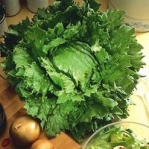
Everyone recognizes these, familiar from supermarket shelves and cafeteria sandwiches. Curiously, the type is quite modern, having been developed only a little over century ago. Compared to all other lettuces, they require more growing space, have longer growing times, are more likely to bolt, are more susceptible to pests and diseases, have less nutritive value, and—by general agreement—have notably less flavor; naturally, they are America’s favorite kind (though not the rest of the world’s).
- Romaine lettuces, also called Cos lettuces (cultivar Speckled Trout aka Forellenschluss shown):

This is a type known since, at the very least, Roman times. It achieved fame in America with the popularity of the ”Caesar Salad”. It has a more distinct and distinctive taste than most other lettuces, a very faintly bitter quality typical of flavored salad greens.
- Batavian lettuces (cultivar Sierra shown):

This wonderful type is scandalously unknown in the U.S. It is perhaps the hardiest of all lettuce types, withstanding summer heat excellently and, by most reports, winter cold as well. Moreover, many think it the best-tasting type of lettuce (sounds a no-brainer, doesn’t it?) On the whole, the type is perhaps best described as “semi-heading”—it doesn’t form a true head, but is not looseleaf either. But individual varities are fairly variable, some heading more distinctly than others.
- Butterhead (or Buttercrunch or Bibb) lettuces (cultivar Buttercrunch shown):

These heat-hardy and gorgeous leafy rosettes are as good eating as they are delightful to look at. They are also sometimes called ”Boston” or “limehead” lettuces. Smaller ones are often used entire as one-person salads (they go wonderfully with a few mushrooms and a simple vinegrette). They are the most popular type in Europe.
- Looseleaf lettuces (cultivar Red Sails shown):

A type which scarcely needs explanation, said to be the most tolerant of heat and cold and the fastest to mature.
Choosing Cultivars
As you see below, we discuss both warm-weather lettuces (always the greatest problem with these heat-hating vegetables) and cold-weather lettuces. If you, like us, would like a steady, year-round supply of lettuce, you will need to succession-plant through the year, adjusting your sowing choices as you move through the seasons. Keep in mind that the rough average for lettuces is about 8 weeks to maturity and adjust your seeding varietal choices for how the weather will be over the next 8 weeks from the sowing date.
You should also do some homework to determine how many lettuce plants to grow. If you feel you would like a fresh head every other day—a not unreasonable average—and the average growing time is, say, 60 days, then you will need to have 60/2, or 30, heads in various stages of growth from just-seeded to harvest-ready. Or, for a head every third day, it would be 20 heads.
Obviously, you need to adjust that for your own tastes, whether you need a head daily or just one a week, or whatever; but the rule of thumb is 60 divided by how many days between heads. (Mind, it’s never going to work out that smoothly: individual heads may grow faster or slower than expected, not every type is even nominally just 60 days of growth, and some can be harvested on a continuing cut-and-come-again basis; but at least it provides you a rough framework for reckoning.)
(We are fortunate in having a large expanse of well-windowed indoor space for plant-growing, and will be trying—starting soon—to grow our lettuces indoors in a set of 21 one-gallon pots.)
Within each class or type of lettuce there are green varieties and red (or red-ish) varieties; we have sought one of each for the various classes.
Summer Varieties
With some moderate care in the handling of our growing area—as described farther down this page—one should be able to grow lettuce all the year round. Lettuce is a cool-weather crop to begin with, and is pretty cold-hardy. While it certainly can’t grow out in the snow, only modest aid should be needed to keep it going. More difficult is summer growing, as lettuces notoriously bolt (go to seed) very quickly in hot weather. The answer there is (we hope and believe) modest protection, such as partial shading, but first and foremost careful selection of cultivars known to be heat-resistant.
A great help here are the results from the Colorado State University’s Lettuce Bolting Resistance Project [archived copy]. We don’t have to rely on seedsmen’s claims or individual anecdotal accounts: we have careful, methodical trial results available.
The general summation of the trials was this:
The Batavian lettuce varieties outperformed the other varieties of lettuce by far. They did not bolt all season long, even in the warmest days…The Butter varieties also performed well.
From that (and a lot of other sources), Batavians are the undisputed kings of heat resistance, far ahead of all other types. Though each Batavian variety will have its partisans, with no runaway winners, after very extensive reading, we would opt for Sierra for a green Batavian and Magenta for a red.
For butter types, among the best green types is good old Buttercrunch, while for a red type there’s Red Cross.
For those who want to see if they can defy the odds, the best summer Romaine types are the green Jericho and the red Rouge d’Hiver. And if you’re really adventurous, you could even venture a crisphead, the aptly named green type Summertime. Looseleafs may also be wasted effort in summer heat; but, if you want to give them a go, the green variety Simpson Elite (not to be confused with “Black Seedless Simpson”) and the red variety Bronze Arrow (but with New Red Fire as a very close runner-up) seem your best bets.
Winter Varieties
Though seed houses make much of certain “cold-hardy” winter lettuces, in truth all lettuces are, by nature, fairly cold-hardy. Rather than shop for especially cold-hardy types (and thus have to have two sets of lettuce seeds, one for hot and one for cold), it makes more sense to try to ameliorate winter growing conditions, something we discuss a bit farther on. Curiously, Batavians, so good in heat, are also pretty resistant to frost, as to a fair degree are butterheads—so one needn’t look for special varieties of those types other than the ones already discussed above under “Summer”.
But if your fancy for lettuces is insufficiently satisfied by Batavians and butterheads, in cooler weather you can mix in Romaines and loosleafs and even, if you like, a crisphead (for a red non-summer heading type, Red Iceberg seems to be Hobson’s Choice). Generally, the lettuces listed for summer can also serve as your winter lettuces, save that instead of Jericho for the green variety, use Speckled Trout (aka “Forellenschluss”)—many think it the best-tasting lettuce of all, though it’s not notably good in peak summer heat (which is why we list Jericho there instead).
Let’s summarize:
- Summer Lettuces:
- Green:
- Batavian: Sierra
- Butter: Buttercrunch
- Romaine: Jericho
- Heading: Summertime
- Looseleaf: Simpson Elite (not “Black-Seeded Simpson”)
- Red:
- Batavian: Magenta
- Butter: Red Cross
- Romaine: Rouge d’Hiver
- Heading: none
- Looseleaf: Bronze Arrow
- Winter Lettuces:
- Green:
- Batavian: Sierra
- Butter: Buttercrunch
- Romaine: Speckled Trout/Forellenschluss
- Heading: Summertime
- Looseleaf: Simpson Elite
- Red:
- Batavian: Magenta
- Butter: Red Cross
- Romaine: Rouge d’Hiver
- Heading: Red Iceberg
- Looseleaf: Bronze Arrow
The Growing Area
In spring and fall, lettuces can be grown outdoors with no special considerations. But if we are to succeed in the cold of winter and the heat of summer, we need to take some measures.
Winter
As we said above, lettuces are by nature cool-weather crops—they supposedly can withstand air temperatures down to perhaps as low as 20° F., so in a region where our average coldest overnight low is 15° F., we don’t need measures so drastic as an actual greenhouse. There are all sorts of “tunnel” and “hoop” systems, of varying degrees of complexity and sophistication (and cost), or you can fake it up on your own. Fortunately, lettuces grow pretty close to the ground, so plant height is not an issue. Another helpful trick is to place transparent quart (or liter nowadays) soda bottles filled with water in among the plants; those will heat up in the sunny day and release the heat at night (a poor man’s version of Walls o’ Water, plus it doesn’t surround the plant).
Summer
To mitigate the warmth, the simplest thing is to provide some shade. A crude way is simple latticed slats set up on the south, east, and west ends of your greens-growing bed. Or you can get fancier by putting up (in the same places) sunshade fabric, of the sort used on house outsides over windows in the summer; or perhaps plastic window-screen roll (fairly inexpensive) would work. If you get relentless sun, make the east and west end coverings solid.
Planting
Timing
We will take it as an assumption that by the means described above, we in this climate (and anyplace the same or warmer) can be growing lettuces throughout the year. To simplify matters, we will also assume that each lettuce will be taken as a whole when ready, though in reality many are “cut and come again” types from which we take leaves without pulling the whole plant; the idea here is just to get a general grasp on numbers.
We already ran through the math a little above on this page, but will repeat it here. If you want a steady, year-round supply of lettuce, you need to succession-plant through the year, adjusting your sowing choices as you move through the seasons. Keep in mind that the rough average for lettuces is about 60 days to maturity and adjust your seeding varietal choices for how the weather will be over the next 8 weeks from the sowing date. You should also do some homework to determine how many lettuce plants to grow.
If you feel you would like a fresh head every other day—a not unreasonable average—and the average growing time is 60 days, then you will need to have 60/2, or 30, heads in various stages of growth from just-seeded to harvest-ready. Obviously, you need to adjust that for your own tastes, whether you need a head daily or just one a week, or whatever; but the rough rule of thumb is 60 divided by how many days between heads. (Mind, it’s never going to work out that smoothly: individual heads may grow faster or slower than expected, not every type is even nominally just 60 days of growth, and some can be harvested on a continuing cut-and-come-again basis; but at least it provides you a rough framework for reckoning.)
Actual nominal days to maturity (from direct seeding) for the lettuce types we recommend, based on averaging seedsmen’s assertions:
- Simpson Elite: 49 days
- Bronze Arrow: 49 days
- Red Cross: 52 days
- Magenta: 52 days [claims amost equally divided between 48 & 60]
- Sierra: 54 days
- Buttercrunch: 55 days
- Speckled Trout/Forellenschluss: 56 days
- Jericho: 59 days
- Rouge d’Hiver: 60 days
- Red Iceberg: 67 days
- Summertime: 69 days
(Keep in mind that lettuces grow faster in warm weather, slower in cold: the difference can be up to a week. The numbers above are overall averages.)
The average of all those types is 57 days—54 days if one excludes the two longer-growing heading types. We used 60 days in our rough reckonings to be conservative.
As you go along, play it by ear and your developing experience; before long, the flow of lettuce will become fairly steady.
Sowing Seeds
Though many always do their lettuces from transplants, it is not problematic to direct-seed for most of the year. The limits, in terms of soil temperatures, are not below 40°F. and not above 80°F. Those are the limits: is is better practice to limit direct seeding to a soil-temperature range of 45° to 75°. (You do have a good soil thermometer, yes?) In our climate, that’s roughly mid-April to early October.
If your soil temperatures seem en route to going outside that range, switch to starting and transplanting seedlings—but remember that you need to be looking ahead on that temperature by the average seeding-development time, which is typically something like a couple of weeks; just subtract the seedling-growth time from the listed “days to maturity from direct seeding” figure to see when to start seedlings.
From seed sowing to germination is around 7 to 10 days. The first leaves to show are the plants’ “baby teeth” (cotyledons), and will soon be followed by true leaves. When the seedlings are showing a set or two of true leaves, put them into the peat (or cow) pot you will transplant them in, wait a week or two, then harden them off for two or three days, then transplant into their final home.
Space lettuces in one-square-foot spots.
The Bed
Lettuces are “greedy feeders”, so be sure that the soil is good and rich for them. Something like 1 to 1½ pounds a square foot of compost or well-composted steer manure every year or two is a good idea (that’s a layer about ½ to 1 inch thick). Though we hope to get lettuces (and other salad greens) growing year round, it’s wise to move the lettuce bed at least annually, to minimize soil-disease risks. (Remember our suggested four- or five-bed rotation plan.)
Growing
Keep them watered well and, perhaps above all, regularly: irregular watering may be worse than scanty watering. Pick lettuce when it looks ready. Grow enough that you can afford to pick when the individual plants are of a modest size, lest you run the risk of having them bolt on you. Many leafy kinds can be harvested a few leaves at a time, which they will then grow back—what’s called “cut and come again” harvesting.
More
Relevant Links
Besides any links presented above on this page, the following ought to be especially helpful.
Odds and Ends
In the Meal
When, in the course of a meal, should the salad be served? Nowadays, in the U.S. (but not usually elsewhere), it is invariably served before the main course—but it was not always so. It seems the Romans early on served it after the meal, owing to its supposed soporific effect; but later, after breeding had tamed the bitterness in early lettuces, they began to eat it at the start of the meal to stimulate the appetite.
Leter, in the heyday of Europeans’ serious attention to food, salad was served following the main course, so as to refresh the palate before going on to the “afters”—cheeses, nuts, and desserts. That remains the custom in most of Europe to this day.
Physiologically—that is, as regards digestion—it seems not to make any real difference whether one eats the salad first or last: it is entirely a matter of how it affects one’s palate. And that strongly suggests that after the main course is the better way. See Salad Before Or After A Meal? from the Italian Garden site for a longer discussion.
Biology
All the lettuces are from the Asteraceae (formerly Compositae) family, the asters, which includes many edible greens and some edible roots.
History
There are today literally thousands of different cultivars of lettuce—all sprung from ancestral wild lettuces that grew (and still grow) in Northern Europe, Asia, North Africa, and even parts of North America. There is good evidence that some sorts of lettuces were being cultivated in Egypt as early as 4500 B.C. Certainly the Babylonians were cultivating it by 3,000 years ago, and the Chinese may have started growing it before them.
Herodotus tells us that lettuce was served on the tables of the Persian kings of the 6th century B.C. In the 5th and 4th centuries B.C., other great Greek writers described and praised its virtues. The Greeks called it tridax, the Persians kahn. The plant’s modern “scientific” (Latin) name, Lactuca, is derived from the Latin root word lac, milk; our English word “lettuce” derives from the French laitue, also meaning milk. That, obviously, is because the plant has a heavy, milky juice. The juice, or sap, was long thought to have significant medical properties: Hippocrates mentions lettuce sap as a medicinal, supposed to induce sleepiness.
By the first century after Christ, Roman writers were describing a dozen distinctly different lettuce types, some of which were fairly common; it is known that lettuces much resembling present-day Romaine cultivars were then being grown. (It was popularly believed in the time of Augustus that he was cured of an illness by eating lettuce.)
Romans first ate lettuce at the end of the meal to capitalize on its supposed sleep-inducing effects; later, as the bitter quality was bred out of the varieties grown, lettuce was eaten at the beginning of the meal to stimulate the appetite.
As in the development of the cabbages, the primitive forms of lettuce were loose, leafy, and sometimes “stemmy” types; the looseheading and firm-heading forms occurred much later. Firm-heading forms had become well developed in Europe by the 16th century, but just when they were first developed is unknown. The oak-leaved and curled-leaf types, and various other colors now known, were all described in the 16th and 17th centuries in Europe.
Columbus evidently carried lettuce to the New World, for its culture was reported on Isabela Island (now called Crooked Island) in the Bahamas in 1494. It was common in Haiti in 1565. When it was introduced into South America is not known, but doubtless it was soon after the Europeans arrived; it was under cultivation in Brazil before 1650.
Lettuces are today used almost exclusively raw, but they can be cooked—indeed, lettuce was normally eaten cooked till the time of Louis XVI, when the Chevalier d’Albignac famously dressed raw lettuce with a vinaigrette.
Envoi
Think lettuce, for all its virtues, is boring? Check out The Lettuce Ladies (this being the 21st century, female readers can check out The Broccoli Boys).
Return to the top of this page.
If you find this site interesting or useful, please link to it on your site by cutting and pasting this HTML:
The <a href="https://growingtaste.com/"><b>Growing Taste</b></a> Vegetable-Gardening Site
—Site Directory—
Search this site, or the web
-
Background Information
about the purposes and design of this site
- Site Front Page
-
Introduction
- An Apologia: why one should cultivate one's garden
- Deep-Bed Gardening (forthcoming)
- Container Gardening (forthcoming)
- Vegetarian and Organic Considerations (forthcoming)
-
Recommended Crops for a home garden, by variety
-
Gardening information and aids
-
Miscellaneous Information of interest to the home gardener
Since you're growing your own vegetables and fruits, shouldn't you be cooking them in the best way possible?
Visit The Induction Site to find out what that best way is!
|
If you like good-tasting food, perhaps you are interested in good-tasting wines as well?
Visit That Useful Wine Site for advice and recommendations for both novices and experts.
|

|
This site is one of The Owlcroft Company family of web sites. Please click on the link (or the owl)
to see a menu of our other diverse user-friendly, helpful sites.
|
|
 Like all our sites, this one is hosted at the highly regarded Pair Networks,
whom we strongly recommend. We invite you to click on the Pair link for more information on getting your site or sites hosted on a first-class service.
Like all our sites, this one is hosted at the highly regarded Pair Networks,
whom we strongly recommend. We invite you to click on the Pair link for more information on getting your site or sites hosted on a first-class service.
|
|
All Owlcroft systems run on Ubuntu Linux and we heartily recommend it to everyone—click on the link for more information.
|
Click here to send us email.
Because we believe in inter-operability, we have taken the trouble to assure that
this web page is 100% compliant with the World Wide Web Consortium's
XHTML Protocol v1.0 (Transitional).
You can click on the logo below to test this page!
You loaded this page on
Thursday, 25 April 2024, at 08:11 EDT.
It was last modified on Wednesday, 26 January 2022, at 02:46 EST.
All content copyright ©1999 - 2024 by
The Owlcroft Company