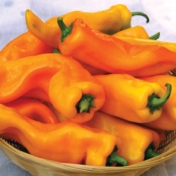
Gatherer’s Gold
|
|
Click here for the site directory. |
|---|---|
| Please consider linking to this site! | Click here to email us. |
Sponsored link/s:
Sponsored link/s:
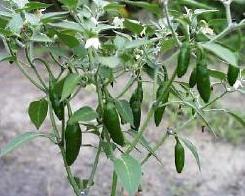
Peppers fall into two primary categories, generally called “sweet“ (or, wrongly, “bell”) and hot. Peppers classified as “sweet“ have been found to be a genetic mutation of the original pepper type, lacking a certain gene that causes the usual hotness. Even so, across both “hot“ and “sweet“ types, there is a broad spectrum of hotness.
Pepper terminology around the world is quite confusing: pepper, chile, chili, Aji, and paprika are some of the terms used in various areas for plants all belonging to the genus Capsicum (yes, the spice paprika—properly pronounced, we are told, PAP-ri-KAH—is just ground dried pepper). There are five domesticated species of Capsicum:
Capsicum annuum is the most extensively cultivated pepper species in the world and subsumes most of the varieties known to the home gardener. It includes, for example, the Ancho, Bell, Jalapeno, Paprika, Pimiento, Serrano, New Mexican, and Thai peppers.
Capsicum baccatum is termed Aji throughout South America. The pods have a distinctive fruity flavor, and can be used fresh in salsas or dried and ground into powders.
Capsicum chinensis includes the fiery Habanero. The small pods are a flattened bell shape with a fruity aroma, and can be used fresh in salsas.
Capsicum frutescens includes the Tabasco plant, which is famously used in hot sauces and salsas.
Capsicum pubescens originated in Bolivia; the common name in South America is rocoto. It is grown in the high-mountain areas of tropical countries and can be stuffed or eaten fresh in salsas.
All bell peppers are “sweet“ peppers, but by no means are all sweet peppers bells: there are scads of sweet pepper types that do not have the characteristic, blocky, lobed bell shape. Most notable are what are usually called “frying peppers“, including some of the best sweet peppers there are. Looking beyond simple consumer familiarity (or lack of it) with sweet types, one can say that bells—which tend to be thick-walled—are chiefly useful for stuffing, whereas the usually thinner-walled fryers are for, well, pretty much any other culinary use of a sweet papper: frying (of course), salads, sandwiches, stews, you name it.
It is worthwhile, at this point, to remark on pepper colors. Peppers, like many common “vegetables“, are technically fruits (hence their seed content). Not surprisingly, they achieve their best eating qualities when they are fully ripe; and when they are fully ripe, their color, for virtually all species and types, is most commonly red—or, for a few, yellow or orange. But many peppers, while yet immature, pass through other stages of color, starting with green. Yes, “green peppers“ are not some distinct type: they are simply peppers picked while still quite immature. Since the taste of a green pepper is (not surprisingly) distinctly less sweet and more bitter than that of a mature pepper (that is how the literature puts it—harsher and more acrid is probably closer to the truth), one can assume that they are a late-developed acquired taste (often thought to have been simply a growers’ marketing ploy to get peppers to market sooner).
The color stages that certain cultivars pass through, and can be picked at, include (per Wikipedia, “green, red, yellow, orange and, more rarely, white, purple, blue, and brown, depending on when they are harvested and the specific cultivar.” The article goes on to add the “Green peppers are less sweet and slightly more bitter than red, yellow, or orange peppers. (“slightly” is their word, not ours.) A statement widely repeated on the web is that “The taste of ripe peppers can also vary with growing conditions and post-harvest storage treatment; the sweetest are fruit allowed to ripen fully on the plant in full sunshine, while fruit harvested green and after-ripened in storage are less sweet.” For quite a while, most of the exotic-colored types were only available to home gardeners as hybrids, but there are now OP versions in pretty much all possible colors.
Perhaps such a spectrum is visually appealing in a salad. But if we want optimum eating, it is wise to avoid any peppers other than red, yellow, and orange types (normally only bells come in any other colors, anyway); purples and browns are almost invariably still not fully ripe. Mind, if you have a definite hankering for the special acridity of green peppers for some particular purpose, fine, grow some; but if you just want peppers for general good eating, well, now you know the drill.
After some seasons in “stamp-collector mode“ as to colored “bell“ sweet types, we have (we feel) regained our sanity, and just grow a red bell (the natural color of a ripe pepper). Tastes vary, but we find bells of minimal culinary use (how often does one want stuffed peppers?), so a single good type suffices for us. For those who would nonetheless like a yellow or orange bell, we have tried to search out good-tasting really early varities of each, and show the results farther below.
As noted above, most sweet peppers that are not bell types are generically referred to as “frying peppers“; these usually have a long, fairly thin appearance, are usually thinner-walled, and (again, as noted) more sweetness. (And are, like bells, almost all red when fully ripe, though also with some orange or yellow.) They are probably the best choice for any culinary purpose other than stuffing requiring a sweet pepper. In many cases, the skin is thin enough that they do not need peeling (as bells sometimes do, depending on the exact application). Note that not a few home gardeners who grow lots of fryers don’t even bother to grow bell types at all.
Growing peppers where we are is easy; getting peppers grown here to ripen on the vine is, well, not easy. If we want green peppers, the garden cart can scarcely hold them, but nice, sweet, red (or yellow or orange)—well, much care in selection is needed. The issue in a short-season climate is, of course, the type’s DTM (“days to maturity”); anything with a DTM over 70 or so gets progressively more of a gamble for ripening as the DTM rises.
That constraint seriously narrows the range of cultivar candidates, though not fatally so. Here are some—but by no means all or anything like it!—good types to consider (all readily available as both seed and transplants):
One other that deserves mention, but which we could not find as transplant offerings, is Melrose, a very sweet, typically 4" to 6" long red pepper. It is much praised by veteran gardeners.
A non-bell sweet-pepper gallery:
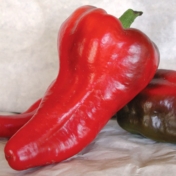
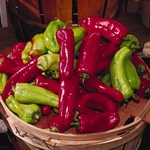
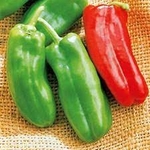
If you’re looking at other varieties than those mentioned above, and there are plenty, watch those DTM values: if they’re much over about 70 days, you are—if your climate is short-season, as ours is—gambling on getting past the green stage. Peppers can be ripened indoors if picked green (or still partly green), but most feel that they lose some flavor that way. You can start seeds indoors for later transplanting, or(for both the mentioned types) you can buy potted seedlings ready to transplant (after a little hardening off).
This class of peppers is delightful. Few things are more appetizing than smelling sweet frying peppers being sautéed with some onion and garlic…
The cultivar selections were influenced by both reported flavor and earliness, since especially for coloring up beyond green, very early-maturing types are essential in a short-season climate. Regrettably, claims are many while assured facts are few. As a simple but expressive example, various seedmen’s quoted days for the common, popular Golden Cal Wonder bell pepper were 68-78, 75, 72, 75-80, 60 green & 78 yellow, 78, 78, and 62-73 (in the order we found the vendors). Note that only one had the decency to distinguish between “ready but green“ and “fully mature“ times. Our sense of it is that if you see “days to harvest“ in the 60s, much less the 50s, they’re invariably talking about “pickable but green“, not fully ripe and colored-up times.
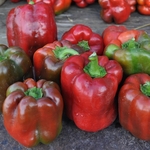
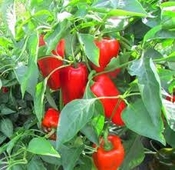
Finding red bells for our climate is not hard, but finding yellow or orange bells is (there’s a reason that supermarket oranges and yellows are pricey). A red bell that is widely recommended for short-season gardeners is King of the North (shown at the right), which we have grown and are growing with good results. (If you commonly experience disease problems, notably Cucumber Mosaic Virus, in your peppers, a good alternative would be Peacework, of which King is one of the two ancestors.) King is listed as about 57 days to green (from transplant) and 68 to 70 days to maturity. (It also is readily available as transplants, which Peacework seems not to be.)
(Peacework might have been our first choice—its productivity seems fine—but trial reports suggest that its flavor is still variable from plant to plant. Plus it’s not as widely available, and we could find no transplant offerings for it.)
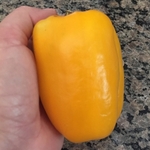
Finding decent orange or yellow bells is a task indeed. For a yellow, the (apparent) best we could find was Canary Bell, an heirloom that takes 70 to 75 days and produces peppers around 3½" by 4". In the UC Master Gardener Program of Contra Costa’s “Pepper Collections for 2021” they say: What an exceptional bell pepper! This pepper is brilliant yellow in high contrast to its deep green foliage, a beauty in the garden. It is crisp, sweet and renowned for its exceptional flavor. With high productivity, what’s not to love about this pepper. (That’s it at the left.)
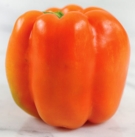
Finding an orange bell suited to short-season growing was harder yet. You could try Horizon, a fairly early orange bell that typically sizes at 4" by 4", quoted as 73 to 75 days (shown at the right). Alternatives include Sunrise Orange, variously quoted as 60 to 80 days, and Orange Bell, a roughly 4" by 3½" pepper with DTM variously quoted from 58 days to 80 days—we did tell you about seedsmen. (Note well that “orange bell” is also used as a generic term for any orange-colored bell pepper; but “Orange Bell”—note the capitalization—is a particular cultivar—read seed-seller offerings with care.
There are countless other bell types; while those above seem—from the literature—as good as it gets, don’t hesitate to try others you may find—but always with a keen eye on their listed growth period (check several sources, preferably some other than sellers).
And yet again: be aware that, if you are growing sweet-pepper cultivars for color, you have to take care pick them when they are just the wanted color, or they will likely go on to a different color (usually just ending up as some shade of red.)
As anyone who has ever taken even the most casual glance at the literature knows, hot peppers are not a vegetable, they are a religion. Here, even more than ever, the observation about taste being a highly personal matter must govern any remarks. That acknowledged, hot peppers strike us as being analogous to roller coasters: most people do the thing not for the enjoyment but to prove something to somebody—perhaps themselves.
Now if you can taste them through the fire, hot peppers really are undeniably delicious, and add a wonderful tang to any number of dishes; but when one gets up into the “Atomic“ heat range (as one seed catalogue categorizes some of its listings), a disinterested bystander must wonder how real the joys of consumption—the gustatory joys, not the psychological ones—are. (But chileheads—so they call themselves—will tell you that if you can get acclimated to the heat, you will much enjoy the undeniable fine flavor.)
(One interesting reason why there may be so many chileheads: capsaicin, the substance that is the “heat“ of hot peppers, causes the generation of endorphins, natural opiates released by the brain to signal pleasure rather than pain—chocolate is also famous for generating endorphins; chileheads are actually getting a mild natural high.)
Pepper heat is commonly measured in so-called “Scoville Heat Units“, which are nowadays (since the 1980s) measured by a procedure called High-Performance Liquid Chromatography (HPLC): the chile pods to be tested are dried and ground up, then the chemicals responsible for the pungency are extracted and the extract injected into the HPLC device for analysis. The scale ranges from zero to many millions of Scoville Heat Units (with the “Carolina Reaper“ currently being the hottest pepper ever measured, at 2,200,000—beyond that are chemical extracts). One thing we find tending to confirm our opinion is that virtually all the articles one turns up in web searches for “hot peppers“ and “taste or flavor“ invariably discuss almost nothing but the hotness of the chiles, not their actual flavor (which is a shame, because the flavor is the point, not the heat).
(We say above “nowadays“ because once Scoville units were measured in a subjective way—the “Scoville organoleptic test”. The substance was diluted with water and tasted, then diluted again, and so on, till the sense of hotness just disappeared—the volume of water needed to dilute to just that point of indetectability was the measure of the hotness.)
(A couple of hot-pepper tips: Capsaicin is found in its highest concentrations—about 80% of the total amount—in the ribs and the seeds of peppers; thus, removing the ribs and seeds will much reduce the heat of a chili pepper; but if you do find your mouth burning unbearably, don’t drink water or beer, which will just spread the capsaicin around in your mouth—eat rice or bread or a tortilla, or—even better—drink milk or eat some yogurt.)
Here we’re going to send a lot of chileheads postal. It is our position that flavor and hotness are separable qualities. There are available countless bottled hot sauces, starting with the famous Tabasco brand, covering all ranges of hotness. It is our position that when you want to cook something with pepper flavors and want it to have some spice heat, you use peppers with flavor but not cataclysmic levels of hotness, then determine for yourself the hotness of the end product by the type and amount of bottled hot sauce you add, during the cooking or as a condiment at table.
Here is a small collection of pages that list and evaluate bottled hot pepper sauces:
That said, here are a few modestly hot peppers that seem well-accepted for their flavor but are not of Atomic heat levels:
TAM Jalapeño - a mild form of Jalapeño, maybe one-half to one-fourth the heat of the standard Jalapeño; 70 days.
Habanada - a very mild form of Habañero, (even the seeds are sweet and add to the flavor); 100 days, so probably needs to be container-grown indoors.
Sweet Datil - a very mild form of the famous Datil; small fruits; 90 days, so might need to be container-grown indoors.
Anaheim - as green fruits turn red, the flavor moves from grassy, earthy notes to a sweeter, more complex flavor enhanced by roasting; excellent for Chile Relleno; 80 days.
Ancho/Poblano - Called Poblano when fresh, Ancho when dried; red fruits are much hotter and more flavorful than earlier green ones; can get 6' tall, wants staking; 68 days green, 75 days deep red.
Hot Portugal - if you want to try a fairly hot (but not Atomic) early pepper, this is one; 70 - 80 days.
We have also thought much about growing one or two pepper types for home-making paprika, but—after extensive reading—decided that if one wants the real thing, one must just buy good imported Hungarian paprika from a reliable supplier (Penzey’s, for example).
(An aside on paprika: There is a lot of confusion extant about the spice paprika. The Hungarians—Europe’s real food connoisseurs—produce several classes of paprika, which are dumbed down for the U.S. market into “sweet“ and “hot“. Real Hungarian paprika, fresh (meaning ground and packaged but not left on a shelf for a year or three) is precious stuff, with no resemblance to what is sold in stores over here as “paprika“, and which various sources have described as “sifted clay“ and “ground bricks“. The Hungarians have, over centuries, settled on the cultivars that work right—and those only grow properly in specific climates, of which even Hungary has only a couple. No, we’ll not venture our own.)
As always with heat-lovers in this climate, choosing the right planting-out time is critical to success. Basically, we want to set our pepper plants out just as soon as temperatures allow. Sources hold that the lower bound of viability for peppers is somewhere from 60° to 70°, and that they must never see frost. In our climate, the average last frost date is in early to middle May—by which time the average daily high is already in the mid-60s. But to be on the safe side, we (and probably you) would target June 1st as the setting-out date for our transplants. And as we never, on average see highs over 90°, our pepper season only ends when daily highs drop below 70°—mid-September— or perhaps at first frost, circa early October. (That gives us over a hundred pepper-growing days, so we may be being over-cautious about DTMs, but better safe than sorry when there are excellent types with acceptable DTMs.)
Pepper seedlings take a long time in the pot before transplant: sources typically say things like “eight to ten weeks or more“. If we use good-size peat pots and go, say, 9 weeks, that takes us back to just about April 1st as when we should be sowing our pepper seedlings—though the conservative might want to make it mid-March to give them a full 11 weeks in pot (so use large pots!).
Peppers, like all heat-loving plants we grow in this climate, need to be started indoors and later transplanted out. The seeds germinate optimally at about 85° F., so heat pads are close to mandatory, as germination is much slower at lower temperatures, and will scarcely proceed at all below about 65° F.
Many people start seedlings in trays, but we like to set them in the pots they’ll be transplanted out in (which are peat pots—at least one grower was emphatic in advising gardeners not to use peat pellets for peppers (but pots are OK). And, since we’ll be keeping them long to plant out hearty, use 4" pots, not the little 2" ones. Grow the seedlings at, ideally, 70° in the daytime and 60° at night, providing plenty of sunlight or artificial growing light. It might be wise to plant a few extra of each pepper type wanted, then cull for vigorous, stocky plants (as opposed to thin, tall, spindly ones) at transplant time.
Plan—as we said above—on growing your seedlings a good 12 weeks indoors—in this climate, you want the strongest possible seedlings for transplanting out. Ideally, seedlings should have buds—but no flowers yet—by transplant time. (Now you see why good-sized pots are wanted.)
(Just a reminder that we ourselves, having the proverbial black thumbs, use purchased potted transplants, because we invariably have problems either getting seedlings started or, if we succeed, in having them survive transplant shock.)
It is quite important that you annually rotate your Solanaceae crops: don’t grow peppers on soil where any Solanaceae—peppers themselves, tomatoes, potatoes, tomatillos, eggplants—have been grown in any of the three prior seasons. Ignoring that rule can, as with cole crops, cause the buildup in the soil of pests and diseases that, once established, are exceedingly difficult to get rid of. As heavy feeders, Solanaceae are an obvious choice to follow legumes (peas, beans), which enrich their soil, in a rotation scheme.
The outdoors pepper bed should, of course, be in a full-sun location. Peppers want well-drained soil, preferably a light, sandy loam that is slightly acid—say pH 6.3—though that is not crucial. They do, like tomatoes, want rich soil, and especially like a strong phosphorus content in the soil. It is close to mandatory in this climate to use plastic mulch (set out a couple of weeks before the anticipated transplant date); and, because peppers, like tomatoes, abhor wet leaves, a drip watering system is also a wise investment. With peppers as with tomatoes, the new red-colored plastic mulches are said to have a definite beneficial effect on production compared to the old standard black plastic.
As your planned transplant date approaches, check the soil temperature: it should be at least 65° F, and if it isn’t, hold off till it is (an extra week or two in pots won’t hurt the seedlings).
Pepper plants can, at least in a deep or raised bed, be spaced as close as 12 inches. It doesn’t hurt, and may help, to provide them with some caging; for these, as opposed to tomatoes, the usual store-bought inverted-cone type things are probably adequate, as most peppers don’t get anything like the size of a tomato plant.
Several sources suggest transplanting out in the evening or on a cloudy day, so as to reduce the chance of the transplants getting sunscald.
Do be sure to first harden off your seedlings before permanently settling them in their garden homes. A few days at 60° to 65° with reduced water will help harden plants and reduce transplant shock. Over-hardened plants grow slowly after transplanting, so have a care.
Warmth-preserving devices such as the well-known “Walls o’ Water“ get a mixed reception. Some feel that pepper plants requiring WoWs have been set out too early and will end up not being as productive over the season as a whole as plants grown well as indoor seedlings and set out at the right time. We concur with that sentiment, but also realize—from exceedingly bitter experience—that killing freezes can occur around here even into early June; we thus feel that WoWs have a place in pepper growing, and that place is as insurance for the first week or two for healthy transplants set out at the right time. When once the transplants have been out a week or so (remember, we are setting them out around June 10th) and are presumably well settled in and recovered from any transplant shock, we can remove the WoWs and put the cages in place. (Some gardeners use a variant technique: they set their cages in place at once, but wrap the cages with transparent or translucent plastic sheeting: that makes a sort of “mini-greenhouse“; though it doesn’t quite duplicate the heat-retaining qualities of the water cells in WoWs, it’s cheaper and a deal simpler, WoWs being a colossal pain in the, ah, elbow to fill and to prop up.)
Another trick is to set either several bricks or a clear plastic bottle or two of water amid your peppers (and any other heat-loving plants); the idea is that they get warmed during the day by the sun, then slowly release that stored heat in the evening.
Pepper plants require continuous growth for satisfactory results: frequent, regular, slow, deep watering works best, preferably by drip irrigation (especially because it is unwise to get their leaves wet). Cool weather can keep plants from flowering, which is why all the heat-gathering and heat-preserving methods mentioned above are wise. Nonetheless, it can also get too hot for peppers: if the temperature under row cover or a cloche (or within a wall o’water) gets over 85°, it is advisable to remove the row cover of cloche or whatever till the temperature drops into the low 80s.
If you have plastic or other mulch, weeds are no problem—otherwise, cultivate well but very carefully, not below an inch deep at most, because if you cut roots, that may well cause water stress on the plant, which will lead in turn to blossom drop (as can even a short dry period, hence the need for frequent, regular watering).
If your plants don’t look robust, or are only a light or pale green, they may be hungry: apply about a tablespoonful of nitrate fertilizer around each plant, after several blossoms have set. But don’t fertilize blindly—if your plants look healthy enough, let them be, lest they ignore fruiting for vegetative growth.
Bell peppers typically produce 7 to 10 peppers a plant, hot peppers more. By report, with bell peppers if you allow the first fruits to mature on the vine (to red or orange or yellow, depending upon the variety), that tend to shut down fruit production. (Non-bell sweet types do not seem to have that problem, being able to put out new fruit with mature ones still on the plant.) On the other hand, bells picked green and subsequently ripened indoors are said to have flavors inferior to vine-ripened ones. So the choice is between productivity and flavor.
To understand that, recall that peppers are fruits—in effect, the plant’s “children”. The plants have, like most or all living things, evolved to maximize the numbers and viability of their offspring. Thus, when its fruit ripens on the plant, the plant “feels” that it has satisfied its task, and ceases producing further fruit; conversely, when the under-ripe green fruit is picked off it, it “feels” that it needs to produce more fruits.
To us, the choice is clear: let them ripen on the vine. We’re not commercial growers: if we want more peppers than our plants have produced with the fruits left to fully ripen, we’ll just grow more plants next season.
Peppers are usually picked when they’ve stopped increasing in size, are firm to the touch, and have reached their expected color. Don’t pull peppers off their plant, because the plant’s branches are rather brittle and you can break them that way: harvest by cutting the peppers off. As the peppers near maturity, inspect your plants daily and harvest what’s ready.
Have a care! Hot peppers should be handled with some caution—the hotter the pepper, the more the caution; wear gloves, and do not put your gloved hand on your face anywhere near your eyes. The peppers are, in principle, safe to handle, but a small cut or bruise might get capasicin on your skin, and that you would not like. (With the really hot peppers, truly extraordinary safety measures are needed in the kitchen, but description of those is beyond our scope here.)
Besides any links presented above on this page, the following ought to be especially helpful.
The peppers, all kinds, belong to the sun-loving Solanaceae family, along with tomatoes, tomatillos, potatoes, eggplants—and the deadly nightshade. The pungency of peppers depends on the presence of a single gene: cultivars lacking that gene are “sweet“ peppers, those with it are “hot“.
Our present taxonomy of peppers is rather a muddle, and the speciation described earlier will likely change in coming years as research advances. There is a good on-line summary of pepper taxonomy available for the curious.
Most experts agree that the wild ancestors of modern peppers first arose in the Amazon basin. Pepper seeds, carried by Amazon and later by Aztec Indians, were then spread throughout South and Central America and north into Mexico. Peppers were bing actively cultivated at least as far back as 6,000 years ago.
The European arrival in the Americas soon brought peppers to Europe; not long thereafter, Portuguese traders brought them to India and south-east Asia, in whose cuisines they are now a long-established staple. Thailanders consume more hot peppers per capita than any other people on Earth, about twice as much as the people of India; the Korean people are a fairly close second to the Thais.
Those interested in getting more detail on how and why hot peppers do what they do on the human palate and in the human gut can visit this site about The Chemistry of Chilli Peppers.
Sponsored link/s:
Sponsored link/s:
If you find this site interesting or useful, please link to it on your site by cutting and pasting this HTML:
The <a href="https://growingtaste.com/"><b>Growing Taste</b></a> Vegetable-Gardening Site
|
Since you're growing your own vegetables and fruits, shouldn't you be cooking them in the best way possible?
Visit The Induction Site to find out what that best way is! |
|
If you like good-tasting food, perhaps you are interested in good-tasting wines as well?
Visit That Useful Wine Site for advice and recommendations for both novices and experts. |

|
This site is one of The Owlcroft Company family of web sites. Please click on the link (or the owl) to see a menu of our other diverse user-friendly, helpful sites. |
|
|
| All Owlcroft systems run on Ubuntu Linux and we heartily recommend it to everyone—click on the link for more information. | |||
Because we believe in inter-operability, we have taken the trouble to assure that
this web page is 100% compliant with the World Wide Web Consortium's
XHTML Protocol v1.0 (Transitional).
You can click on the logo below to test this page!
You loaded this page on
Thursday, 25 April 2024, at 10:07 EDT.
It was last modified on Wednesday, 26 January 2022, at 18:18 EST.
All content copyright ©1999 - 2024 by The Owlcroft Company