Owing to the screen size of your device, you may obtain a better viewing experience by
rotating your device a quarter-turn (to get the so-called "panorama" screen view).
|
This page updated for 2022.
|
Click here for the site directory.
|
|
Please consider linking to this site!
|
Click here to email us.
|
Shallots
(Allium cepa ascalonicum)
Cultivars
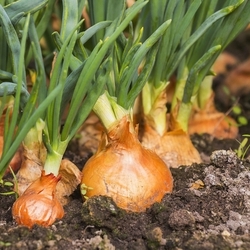
Shallots fall somewhere between vegetables and condiments; one can make onions a dish unto themselves, but it’s hard to imagine serving shallots as a distinct dish (though some include them whole in stir fries). Whatever, they are a cooking, and thus gardening, essential.
In reality, a shallot is (as its “scientific” name, Allium cepa, suggests) just a special kind of onion—one with “more interesting” flavors (as one source puts it) than standard bulb onions. They are best and most productive fall-planted for overwintering (best with at least some protective mulch) with harvest the following autumn.
From a French herb and spice company’s web site:
There are two types of shallots: the gray shallot and the pink, or “Jersey” shallot. The former has a long bulb covered with thick gray skin, from which it gets its name, and a white/purplish flesh. The latter is divided into several types all having a copper tint including long shallots, with yellow or purple bulbs with a strong flavor; half-length shallots, pinker or redder with a fruity flavor; and round shallots with a mild flavor.
Many aficionados hold that the gray is the only “true” shallot, but—as you see—even the French are not adamant on that distinction. The gray is commonly held to be somewhat better for culinary purposes, but its drawback is that it is not a long keeper—quite the contrary (two or maybe three months maximum)—whereas the red (or rose or pink) kinds usually are long keepers, good for possibly up to as much as a year in ideal conditions. The gray is hard to find in the western hemisphere; most seedsmen just offer a yellow and a red, however denominated (“Dutch yellow” and “French red”—reportedly the most common dry shallot grown—are common). The gray is claimed to actually be a distinct species: Allium oschaninii. The “Dutch yellow” may be the dreaded seeded shallot (dreaded by the French growers who believe that only a vegetatively propagated shallot has real shallot quality).
Another expert source had this to say:
The difference between a multiplier onion and a shallot is somewhat arbitrary, and they are often lumped together. Commercially however, those with yellow or brown scales and white interiors, such as the ’Dutch Yellow’ type, are usually classed as multiplier onions, while those with red scales and, supposedly, a distinctive and more delicate flavour, are classed as shallots.
As you see, which is what gets complicated and is somewhat subjective (and often heated). A link farther down this page by a woman who now lives—and cooks and shops—in France, distinguishes, like the quotation above, between gray and red “Jersey” shallots, which latter come in the shops as long and “half-long” types. Whether those are the same as the often-encountered “French red” of seedsmen’s catalogues is hard to say for sure (but it seems likely).
The thing to do, it seems to us, is to grow some of each; we don’t grow all French because they won’t keep long enough to supply us year round (3 to 5 month if well stored), whereas a Dutch Red (a true, not-from-seed type) will, says one grower, “keep for well over a year with proper storage conditions”. So we advise a mix of Dutch Red (make sure it’s a not-from-seed type!) and French Grey. (The links are to one reputable seedsman's site, but others no doubt carry the same types: buy local.)
It is said that shallots can successfully be grown in containers, very possibly even indoors; the problem there is that if your planting doesn’t work, it takes an awfully long time to discover it. Still, it’s probably worth the effort to have a continuing supply of the true French shallot.
Note that shallots are close cousins—arguably sisters—to “potato onions”, discussed here on our main onions
page.
Planting and Growing
Shallots are normally grown from small starter shallots: there is now true seed available, but it is all hybrid (and so replanting the resultant bulbs may—opinions seem to differ—produce off types), whereas once you get shallots growing in your garden, you have them forever by just saving out a small part of each year’s crop as next year’s starters.
Timing
Choose carefully when you intend to plant, for “seed” shallots (bulbs) are living things, not dried seeds in a packet, and need to be delivered only shortly before planting time. In this climate, we are much better off using fall planting for overwintering and harvest in late summer or early fall of the following year. The specific advice on the page linked below is that “planting 4-6 weeks before hard winter comes is about right.” Regrettably, “hard winter” is less than definite as a guideline; but if we take it to mean when hard (below 29°) freezes start to become regular, for us that’s early to mid-October, so if we back up from that by, say, five weeks, we arrive at September 8th. (The old rule-of-thumb saying is “Plant on the shortest day, lift on the longest day,” but that’s for other climes and other times.)
Planting Out
In our opinion, it would be fatuous of us to set forth the somewhat complicated and detailed instructions for dealing with shallot-growing when an excellent set is already available on line. Here is a link to the on-line page How to Plant Shallots from WikiHow (note: in a deep-dug bed, you can use 4" spacing, or 6" if you’re conservative). But that information, copious as it is, still leaves the gardener one other decision to make.
That decision is how much seed shallot (meaning bulbs) is wanted for the number of plants to be grown, for seed shallots are sold by weight, not count. A pound of seed shallots is said to plant 15 feet in a row at a spacing of 4 to 6 inches (that is, 2 or 3 to the foot), which translates to 30 to 45 plants to the pound; for a first season, it is probably as well to be conservative and use the figure of 30 to the pound.
Of course, you also need to know how many plants you intend. You can, as a rough estimate, figure that shallots will grow about 5 or 6 times what you use planting them, so plant about one-fourth as many as you reckon you’ll need, keeping in mind their keeping qualities (one-fourth, not one-fifth, because you need some for seed next season). As to space requirement, Jeavons, in his deep-bed book, set 4 inches as the spacing; recall that in a deep bed, one usually plants on sort of triangular or diamond block patterns, rather than in rows. More conventional advice, for gardeners who do not use deep-dug or raised beds, is 4 to 6 inches of spacing in rows 18 inches apart. (That may give you a clue as to why deep-bed gardening is so much more productive for the square footage of garden.)
You can harvest shallots at any green stage you like and they are delicious that way in salads. Otherwise, harvest them like onions (which, in essence, they are) in the spring following your planting them.
More
Relevant Links
Besides any links presented above on this page, the following ought to be especially helpful.
Odds and Ends
Biology
Shallots are a variety of the Alliaceae family, the alliums (till recently called the Lilliaecae family). Besides such obvious relatives as bulbing onions, leeks, scallions, and garlic, the shallot’s kin also include lillies and hyacinths.
History
Shallots are apparently not found anywhere wild, and so must have originated through human breeding from other shallot-family members, They are thought to have originated in ancient Ashkelon, a city in Palestine—where a Ms. Delilah once famously barbered a Mr. Samson—hence their name ascalonicum. There is evidence that they were a common ingredient in ancient Egyptian cooking; certainly they were widely grown in both Greek and Roman gardens. The varieties that we use today are probably more or less the same as those used thousands of years ago.
Envoi
Tennyson wrote a well-known poem, “The Lady of Shallot”, that has nothing whatever to do with shallots the vegetable, and whose mention is thus always good for a crude, Philistene laugh.
Return to the top of this page.
If you find this site interesting or useful, please link to it on your site by cutting and pasting this HTML:
The <a href="https://growingtaste.com/"><b>Growing Taste</b></a> Vegetable-Gardening Site
—Site Directory—
Search this site, or the web
-
Background Information
about the purposes and design of this site
- Site Front Page
-
Introduction
- An Apologia: why one should cultivate one's garden
- Deep-Bed Gardening (forthcoming)
- Container Gardening (forthcoming)
- Vegetarian and Organic Considerations (forthcoming)
-
Recommended Crops for a home garden, by variety
-
Gardening information and aids
-
Miscellaneous Information of interest to the home gardener
Since you're growing your own vegetables and fruits, shouldn't you be cooking them in the best way possible?
Visit The Induction Site to find out what that best way is!
|
If you like good-tasting food, perhaps you are interested in good-tasting wines as well?
Visit That Useful Wine Site for advice and recommendations for both novices and experts.
|

|
This site is one of The Owlcroft Company family of web sites. Please click on the link (or the owl)
to see a menu of our other diverse user-friendly, helpful sites.
|
|
 Like all our sites, this one is hosted at the highly regarded Pair Networks,
whom we strongly recommend. We invite you to click on the Pair link for more information on getting your site or sites hosted on a first-class service.
Like all our sites, this one is hosted at the highly regarded Pair Networks,
whom we strongly recommend. We invite you to click on the Pair link for more information on getting your site or sites hosted on a first-class service.
|
|
All Owlcroft systems run on Ubuntu Linux and we heartily recommend it to everyone—click on the link for more information.
|
Click here to send us email.
Because we believe in inter-operability, we have taken the trouble to assure that
this web page is 100% compliant with the World Wide Web Consortium's
XHTML Protocol v1.0 (Transitional).
You can click on the logo below to test this page!
You loaded this page on
Thursday, 25 April 2024, at 17:11 EDT.
It was last modified on Wednesday, 5 January 2022, at 20:45 EST.
All content copyright ©1999 - 2024 by
The Owlcroft Company