Owing to the screen size of your device, you may obtain a better viewing experience by
rotating your device a quarter-turn (to get the so-called "panorama" screen view).
|
This page updated for 2022.
|
Click here for the site directory.
|
|
Please consider linking to this site!
|
Click here to email us.
|
Hardy Kiwis
(Actinidia sp.)
About Hardy Kiwis
The kiwi is a small, soft-fleshed fruit with a delectable and distinctive taste. The kiwi is really a vine not a tree, but it grows so large that one needs to treat it much like a tree, so we include it in this tree-fruit section.
Kiwis come in two broad classes: the “standard” kiwi (often called the “fuzzy kiwi”), A. deliciosa, which is perhaps lemon-sized and which has a fuzzy skin requiring that it be peeled before use, and the smaller “hardy kiwis”—A. arguta, A. kolomikta, and A. polygama—which can be eaten entire, rather like a good-sized grape. (There is another, the “Chinese kiwi”, A. chinensis, not yet much seen outside of China, though it is very popular there.)
The fuzzy kiwi, though it long dominated the rapidly growing kiwifruit market, is the least flavorsome of the types, and also the greatest nuisance to prepare or eat, owing to its skin. The so-called “hardy kiwi” types are now emerging as the preferred alternative, inasmuch as they may be eaten out of hand, are better tasting, and have a wider growing zone. Of the hardy-kiwi species, A. polygama, known as “silver” kiwi, is reported by some to be of good eating quality, but researchers at Oregon State University reported that “we have not had good success with this species at NWREC. Our fruit goes from green and unripe to orange and soft with an astringent peppery flavor. Plants are moderately vigorous, but more susceptible to cold injury than arguta or kolomikta.”. We will thus confine our attention here to the species A. arguta (commonly just called “hardy kiwi”) and A. kolomikta (commonly called “Arctic Beauty”). Choosing between those two is not a simple matter, and we discuss that more a little farther down this page.
Four important things to know about growing hardy kiwis:
- Male and female flowers are borne on different plants, so both male and female vines must be planted, preferably interspaced for optimum pollen spread (one male vine can pollinate 5 to 8 female vines).
- The plants often take several years to mature—from 3 to as many as 9 years (though more than 3 is unusual, and some are even quicker).
- Though the plants are extremely winter-hardy, they develop shoots early in the spring that are quite sensitive to frost. There can be “shoot burn” in many years; though the plant usually survives, regrows, and eventually fruits despite, fruit will not develop that year.
- Hardy kiwi are extremely vigorously growing vines, requiring a substantial supporting trellis.
But, as one source says, Despite the challenges, once one has sampled the fruit, kiwi growing seems well worth the trouble. The fruit is aromatic, with fuzzy kiwi, banana, strawberry, and pear flavors all wrapped up in one delightful package.
(There are at least two cultivars of Actinidia kiwis that are described as “self-pollinating”: Issai and something with the charming name “119-40-B”. Issai is well-known to be smaller and less hardy than other types of arguta cultivars; though it is also quicker to set fruit—often doing so in its second year—it also does not, absent a pollinator, set as much fruit as with pollination, so the “self-fertile” is technically true but something of a cheat. Of 119-40-B, it is said “A self-fertile selection from the Arnold
Arboretum in Massachusetts. Seemingly otherwise typical of the species and useful as a pollinizer for other hardy kiwi clones.”)
Hardy Kiwi Cultivars
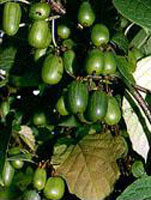
A. arguta versus A. kolomikta
The decision involves a trade-off. Actinidia kolomikta is very cold-hardy as a plant: that is, the basic plant reportedly can remain alive through winter temperatures as extreme as -40°F. But kolomikta requires materially fewer chill hours than arguta, and thus breaks bud materially earlier, and the buds are not frost-tolerant. There is thus a significantly greater risk with kolomikta types that they will break bud before winter’s end, perhaps during a brief mild spell, then have the blossoms be massacred by chill temperatures. That can certainly also happen with arguta types, but the risk is a little lower.
The decision point would seem to be just how cold your winters can get. Actinidia arguta can withstand temperatures of -10°F. to perhaps-25°F. (depending, one supposes, on the particular variety). If you can get winter temperatures below that range (but still above -40°), you are more or less obliged to grow an A. kolomikta type; if not, you are better off growing an A. arguta type. (And don’t go by just “average” lowest temperatures: you need to go by once-in-ten-years lows, because otherwise a particularly cold winter—which is bound to happen at some point—will wipe out your plantings, meaning you have to start all over again.)
We should perhaps emphasize that point: A. kolomikta types often bear a decent amount of fruit in their very first season after being planted out, whereas A. arguta types can take two or three years (occasionally, depending on your exact growing conditions, even more) before they bear useful amounts of fruit. So losing an A. arguta planting is not just a matter of planting anew: it’s a matter of planting anew and waiting a few years.
Oh, and something else to add into the decision mix: A. kolomikta types require substantial shade. Grown in full, steady sun, they do not thrive, and indeed often just die. They want no more than at most a few hours a day of direct sun. A. arguta types do not seem to have that problem.
Also know that A. arguta types are “very vigorous”; that means that they tend to grow wildly and take over the space around them (and they sucker plentifully). The vines can get quite thick (to where cutting them requires a saw), and given opportunity will grow seemingly forever (there are reports of 50-foot vines). More than one gardener has posted that he removed his A. arguta plantings because the maintenance had gotten far too tedious (and the removal isn’t easy). Indeed,
A. arguta types are now considered invasive. Now you know….
Particular Cultivars
A. kolomikta Types
Regardless of study results, you can’t grow what you can’t buy. Choices of type are limited to what seedsmen offer. What we have seen offered of A. kolomikta types are listed below. Be reminded that the frequently found offering “Arctic Beauty” is not a particular type; it is, rather, a designation for the entire kolomitka species, and as a designation of type is meaningless—in effect, “here is some generic A. kolomikta plant.” The named cultivars we could find are:
- Red Beauty
- Krupnoplodaya
- Emerald *
- Frost *
- Hero *
- Sentyabraskaya aka September Sun *
- Viktor *
(Variety names marked with an * asterisk are trademarked.)
There are also numerous listings for male A. kolomikta vines, all with no variety specified (but that really doesn’t matter, as the male vines do not normally fruit).
What do we know of particular cultivars? In Europe, and latterly China, there are large numbers of cultivars; there has been an especial development effort in the Baltic nations (notably Lithuania), whence many of the better cultivars available today (and why so many of them have Slavic-sounding names). But all we have are the ones listed above (unless you find something we missed).
First off, one study of kolomitka types found that “The differences in the time of bud burst, blooming, shoot growth and leaf fall comprise only 2 - 3 days for all of the cultivars studied, while the harvest maturity differs more considerably.” So we aren’t going to get around the bugaboo of early budding by cultivar selection. Also, “Except for one-year–old plants of cultivar “Lande”, which showed rather medium winter hardiness, other investigated cultivars wintered poorly. However, the two-year-old plants were sufficiently hardy [in all tested cultivars].” So cultivar type doesn’t make much difference there, either (inasmuch as “Lande” seems unavailable).
(Always keep in mind that kiwi vines of both species are very cold-hardy after their first year; in their first year, they can be rather frost-tender, and need appropriate measures taken to survive that first winter.)
If there are rational criteria for making cultivar choices, they are hard to discover. You can review the various links we provide farther down-page to see what you think about others’ experiences and claims.
A. arguta Types
There are quite a few cultivars available. Here we follow the University of Minnesota’s advice in Choosing kiwiberry varieties, inasmuch as their base climate sems quite similar to ours (their last-frost date in the Twin Citiesa area is around May 15th, as is ours). We will here simply quote (in part) from that quite useful page:
Although data is not available for all varieties you might find for purchase, some anecdotal evidence has suggested that a few varieties show reliable cold hardiness. “Natasha” and “Tatyana” are two more accessible fruiting varieties that have been observed as showing reliable cold hardiness and production in Minnesota. Both of these varieties produce round green, sweet fruits. Some people who have tasted “Natasha” describe it as having a sweet, mango-tropical flavor…“Andrey” is sold as a cold hardy pollinizer for these two fruiting varieties…
If you like a challenge, “Issai”, “Ananasnaya” [aka “Anna”], “Geneva 3”, and “Hardy Red” are more popular fruiting varieties that can be readily found online for purchase but might be considered more susceptible to cold damage in Minnesota. “Issai” is currently the only self-pollinating variety available but certainly fruit might be improved with a pollinizer. “Ananasnaya” (also found as “Anna”) and “Geneva 3” are both noted as having green flesh and interesting tropical flavors. “Hardy Red” is a red-fleshed variety that starts as green and develops a deep red coloration as the fruit ripens. “Meader” is typically listed as an appropriate pollinizer for “Geneva 3” and the others mentioned here.
The cultivars named above seem all readily available in the marketplace. Let’s summarize them:
- Good Cold Hardiness:
- Natasha
- Tatyana
- Andrey [male pollinizer for any of the others]
- Marginal Cold Hardiness:
- Issai [self-pollinating]
- Ananasnaya [aka Anna]
- Geneva 3
- Hardy Red [don’t confuse this with “Ken’s Red”, an even less-hardy type]
Frankly, we don’t see the point of considering those types considered a “challenge”, inasmuch as they offer no obvious advantage over the hardier ones, but there they are…
Kiwi Culture
These are just a few summary notes—consult the various web pages linked farther below for more detail.
Conditions
Hardy kiwis of both species prefer a sound, loamy, pH-neutral soil. Above all, the soil drainage must be perfect. Full sun is said to be best for good fruit production on arguta types, but pernicious for kolomitka types, which require partial shade. Either way, the vines should definitely be well-sheltered from wind, especially in the colder months.
A. kolomikta is inherently quite cold resistant (but see farther below), with dormant plants hardy down to, it is claimed, -40°F. The chief problem encountered in growing kolomitka kiwis is that they are fairly low-chill plants, meaning that they are all too likely to break bud a lot sooner than we’d like, and consequently encounter freeze damage to the developing buds (even though the plants are safe enough). In a bad year, spring freeze damage can mean no crop that year.
The vines grow well on a wall, and can also be grown into trees. They are vigorous climbers, and require a sturdy support.
If you are growing kiwi vines, beware! Cats are very fond of these plants—reportedly more so even than of catnip—and can easily destroy them by scratching at them.
Growing
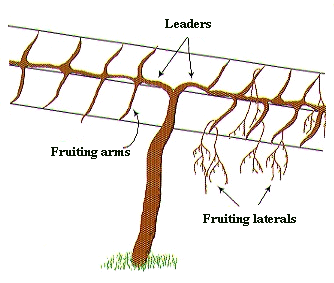
Plant the largest vines available, allowing one (nonfruiting) male for up to eight (fruiting) females. One approach is to support the vines on a T-trellis that is about six feet high and wide, with 3-5 wires (#12) strung between the arms of the T. In that scheme, space posts sixteen feet apart, with plants at half that distance, as shown at the right.
Although hardy kiwifruits are, as their name implies, cold hardy, that cold-hardiness comes only with age; young plants (especially first-year vines) commonly freeze back, delaying production. So plant the largest vines you can get hold of, and protect the developing trunks from winter sun and cold with “Tree-Shelters”, corn stalks, burlap, pipe insulation, or tree-wrap material. Keep in mind that the trunks of hardy kiwifruits are rarely exposed to full sunlight in the wild, so don’t be afraid to wrap them well.
Fruit is produced on second-year wood, or on fruit spurs on older wood; pruning is best carried out in the winter, while the plant is dormant.
Prune annually. Remove 70% of the wood—all the spent, misplaced, and tangled wood—leaving approximately 30% percent, composed of the previous year’s new growth. When plants are young, be sure you have one trunk, two cordons, and last year’s pencil-sized new lateral growth (fruit spurs - close nodules). Removing more than about 70% will throw the plant out of balance and it will become vegetative the following year: you need last year’s fruit spurs present. [adapted from a post by David Jackson & Holly Laubach, Kiwi Korners.]
The fruit should be picked during what is called the “technical maturity phase”, because after that they get soft rapidly and their skin starts to break. One source reported that the technical maturity of mid-season kolomikta kiwi cultivars starts about 58 to 66 days after their full bloom, though another source referred to picking around 50 days after pollination. With those very rough guidelines, a little experimenting the first time a vine fruits should give sufficient insight.
More
Relevant Links
Besides any links presented above on this page, the following ought to be especially helpful:
(And don’t forget that we have listings of nurseries on our suppliers page.)
Odds and Ends
Biology
The genus Actinidia contains about 60 often quite various species. All Actinidia species are perennial, climbing, or scrambling plants; most are deciduous, though a few from warmer areas are evergreens. All species appear to be dioecious: that is, the flowers on male vines produce viable pollen but lack a properly developed ovary, ovules, or styles, while the flowers of female vines appear perfect, but the pollen they release is shrivelled and non-viable. That all means that one must have both male and females vines present to produce fruit.
The fruits of the various Actinidia species are all berries, in that they are fleshy, have many seed embedded in the flesh, and do not split open at maturity. Horticulturally, however, they display great diversity, often in the attributes that are important to growers. For example, the fruit can occur singly, in small bunches of three to five fruit, or sometimes in larger bunches or infructescences containing up to 30 or more fruit. They can vary in size, shape, hairiness, and external color. Some species change color as they ripen. The flesh can also vary in color, juiciness, texture, and composition. The fruits of some species are basically inedible or, at best, unpalatable, whereas the flavor of the fruit of others is considered superb.
The four species of use for edible fruit are A. deliciosa, the “standard” kiwifruit; A. chinensis (only recognized as a distinct species in the early 1980s), a type a bit smaller, and much more nearly hairless, than A. deliciosa and reportedly of much better flavor, and now very popular in China; A. arguta, which is the more common sort of what is now called the “hardy kiwi”, and has a significantly better flavor than the “standard” kiwi; and A. kolomikta, (the “Arctic Beauty” species) another “hardy kiwi” that is even hardier than A. arguta.
History
The kiwi, unlike most common fruits, is a strikingly modern development. A mere century ago it was just a wild plant growing in China; by 1970, it had been developed into a major new fruit crop in New Zealand. Today, the kiwi is an important commercial crop grown in several regions of the world: it has also become an important element of international trade , the three biggest producer countries exporting almost all the kiwifruit they produce. Total world production now exceeds that of such well-established crops as raspberries and currants, and is likely to soon exceed the production of strawberries and apricots.
Almost all kiwifruit cultivars being grown in orchards outside China are descended from just three plants—two female and one male—themselves derived from a single seed introduced to New Zealand in 1904, a seed probably collected at Hubei or Sichuan in China.
Envoi
Kiwifruit contain large quantities of the enzyme actinidin, which will tenderize meat, for those who still eat dead animals.
Return to the top of this page.
If you find this site interesting or useful, please link to it on your site by cutting and pasting this HTML:
The <a href="https://growingtaste.com/"><b>Growing Taste</b></a> Vegetable-Gardening Site
—Site Directory—
Search this site, or the web
-
Background Information
about the purposes and design of this site
- Site Front Page
-
Introduction

- An Apologia: why one should cultivate one's garden
- Deep-Bed Gardening (forthcoming)
- Container Gardening (forthcoming)
- Vegetarian and Organic Considerations (forthcoming)
-
Recommended Crops for a home garden, by variety
-
Gardening information and aids
-
Miscellaneous Information of interest to the home gardener
Since you're growing your own vegetables and fruits, shouldn't you be cooking them in the best way possible?
Visit The Induction Site to find out what that best way is!
|
If you like good-tasting food, perhaps you are interested in good-tasting wines as well?
Visit That Useful Wine Site for advice and recommendations for both novices and experts.
|

|
This site is one of The Owlcroft Company family of web sites. Please click on the link (or the owl)
to see a menu of our other diverse user-friendly, helpful sites.
|
|
 Like all our sites, this one is hosted at the highly regarded Pair Networks,
whom we strongly recommend. We invite you to click on the Pair link for more information on getting your site or sites hosted on a first-class service.
Like all our sites, this one is hosted at the highly regarded Pair Networks,
whom we strongly recommend. We invite you to click on the Pair link for more information on getting your site or sites hosted on a first-class service.
|
|
All Owlcroft systems run on Ubuntu Linux and we heartily recommend it to everyone—click on the link for more information.
|
Click here to send us email.
Because we believe in inter-operability, we have taken the trouble to assure that
this web page is 100% compliant with the World Wide Web Consortium's
XHTML Protocol v1.0 (Transitional).
You can click on the logo below to test this page!
You loaded this page on
Friday, 26 April 2024, at 11:32 EDT.
It was last modified on Monday, 24 January 2022, at 05:51 EST.
All content copyright ©1999 - 2024 by
The Owlcroft Company