Owing to the screen size of your device, you may obtain a better viewing experience by
rotating your device a quarter-turn (to get the so-called "panorama" screen view).
|
This page updated for 2022.
|
Click here for the site directory.
|
|
Please consider linking to this site!
|
Click here to email us.
|
Peaches and Nectarines
(Prunus persica)
About Peaches and Nectarines
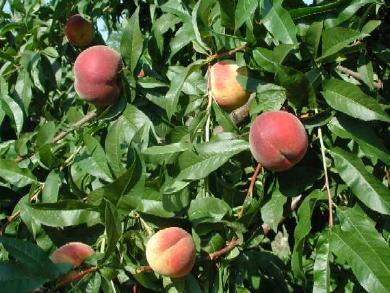
First off, let’s clear away any confusion between “peaches” and “nectarines”. A nectarine is just a fuzzless peach. The end. Wasn’t that easy? (“Though grocers treat fuzzy peaches and nectarines as different fruits, they belong to the same species.”)
To us, these are for maybe a little fresh eating, but mostly pies and other baked confections. Peaches being self-fruitful, those not needing a very great lot of them can do with a single tree.
Peach types further divide in a couple of ways: yellow vs. white, and clingstone vs. freestone. One source says that “Peaches with white flesh typically are very sweet with little acidity, while yellow-fleshed peaches typically have an acidic tang coupled with sweetness, though this [varies greatly]…Europeans and North Americans have historically favoured the acidic, yellow-fleshed kinds.” Take it for what it’s worth. As to the stoning “habit”: in “clingstone” peach types, the flesh literally “clings” to the stone, and has to be cut away with a knife (or one’s teeth); in “freestone” types, the stone easily separates from the flesh. Older peach types are clingstones, but nowadays such types are used almost exclusively for processing rather than dessert use, owing to the annoyance that clinging can be. There seems to be no noticeable difference in flavor or eating quality (other than mechanics) between the types.
In the cold-winter/dry-summer climate we have, peach-leaf curl, the commonest major peach-tree disease, is rare, so disease resistance is not, for us, a major consideration in cultivar selection, a pleasant change. Our biggest issue is cold-hardiness. With peaches, as with several sorts of fruit, it is not really the hardiness of the plant or tree that is the crux, but rather the “bud hardiness”. Virtually all peach-tree varieties, regardless of how early or late they actually fruit, set blossoms within at most 2 or 3 days of one another. If it is too cold out, the blossoms will be damaged (“toast” one source put it) and will not fruit. So the desideratum, for us, is bud hardiness.
Selecting Peach Trees
Selecting Cultivars
A problem here is that hardiness seems often to be inversely related to flavor—not invariably, but commonly. After much poking about, we found that the peach varieties most commonly mentioned as being notably hardy included “Reliance” and “McKay” (aka “Wisconsin Balmer”). But trumping them all is the remarkable new line of peach cultivars called by its creator the “Flamin’ Fury”® line.
That “Flamin’ Fury”® line—also including at least one nectarine—was developed by Paul Friday; it has received excellent reviews from third parties and its member types are now carried by many of the most respected nurseries (Friday was twice president of the National Peach Council). We say all that because the claims for these peaches may, at first, seem hyperbolic; but the credentials are certainly there. Friday works in Michigan, so we can be pretty well assured that his line will do well in our sort of area, though it still behooves one to choose carefully from his two dozen or so types. Unless you are a commercial grower, you would buy his trees through one of the many retail nurseries carrying them (but don’t rely on the listing on his site, which is inaccurate both ways—omits some, includes some not stocking it). Since we first discovered these, we see more and more nurseries stocking them, including local-region houses.)
For us and anyone in a marginal peach-growing area, the clear choice is the Flamin’ Fury PF-24C (called “Cold Hardy” [scroll to page bottom], a clue. (Do not confuse it with their PF-24-007, which is a different variety.)
Selecting Rootstocks
As with all fruit trees, there is also the question of the rootstock. Fruit trees are often grafts of two elements: the upper part, which we select by name as we have been doing above, is the “scion”, and the lower part is, aptly, the “rootstock”. Choice of rootstock is very important, for it controls many qualities of the tree, from size to budding. For peaches, many growers use the tree on its own rootstock; others like the “Kyrmsk 1” rootstock,
which is somewhat dwarfing, very cold-hardy, supposedly good in heavier clay soils (typical of our region), and—notably—is said to induce an earlier fall shutdown and hardening off (which is very good—many fruit trees are damaged by remaining non-dormant too late into early winter). But all we saw for the 24-C was on own rootstock, so there doesn’t seem to be a choice. (Several nurseries carry the 24-C, but it is often out of stock, so be sure if you’re ordering it, to order early and verify availability.)
Growing Peach Trees
Rather than re-invent the wheel, we here refer you the peach-growing pages of the links list farther below.
More
Relevant Links
Besides any links presented above on this page, the following ought to be especially helpful:
(And don’t forget that we have listings of nurseries on our suppliers page.)
Odds and Ends
Biology
The peach is a small deciduous tree of the subfamily Prunoideae of the amazingly utile family Rosaceae. It is classified, with the almond, in the subgenus Amygdalus within the genus Prunus, distinguished from the other subgenera by its corrugated seed shell.
The leaves are lanceolate. Flowers are produced in early spring, prior to the leaves; they may be solitary or paired, and are pink with five petals. The fruit is a “drupe” (a stone fruit), with a single large seed encased in a reddish oval hardwood stone (“pit”); they have yellow or whitish flesh, a delicate aroma, and a velvety skin that bruises easily.
History
Peaches come to us from China, where they are a classic foodstuff, their cultivation being recorded at least as early as the 10th century B.C. Naturally, the Chinese, devoted to the fruit, developed a veritable myriad of cultivars.
Our modern word “peach” harks back to about 300 B.C., when the Greek philosopher Theophrastus—wrongly believing the fruit to have originated in Persia—named it after that region. His confusion likely arose from the common importing of peaches from Persia (also mentioned in Roman records). The peach is believed to have reached continental Europe at around the time of the birth of Christ, though they do not seem to appear in England till about 1650.
Curiously, the fuzzless nectarine type does not appear in any peach citations from anywhere in the B.C. eras; they are not mentioned till 1720, in the then-new American colonies, where they are grown along with standard peaches in Virginia. The famed peach researcher A. J. Downing has recorded 19 nectarine races as extant in America in 1857.
Envoi
Never plant a peach or nectarine anywhere near an almond tree. The two—closely related—would likely cross-pollinate, yielding very bitter almonds.
Return to the top of this page.
If you find this site interesting or useful, please link to it on your site by cutting and pasting this HTML:
The <a href="https://growingtaste.com/"><b>Growing Taste</b></a> Vegetable-Gardening Site
—Site Directory—
Search this site, or the web
-
Background Information
about the purposes and design of this site
- Site Front Page
-
Introduction
- An Apologia: why one should cultivate one's garden
- Deep-Bed Gardening (forthcoming)
- Container Gardening (forthcoming)
- Vegetarian and Organic Considerations (forthcoming)
-
Recommended Crops for a home garden, by variety
-
Gardening information and aids
-
Miscellaneous Information of interest to the home gardener
Since you're growing your own vegetables and fruits, shouldn't you be cooking them in the best way possible?
Visit The Induction Site to find out what that best way is!
|
If you like good-tasting food, perhaps you are interested in good-tasting wines as well?
Visit That Useful Wine Site for advice and recommendations for both novices and experts.
|

|
This site is one of The Owlcroft Company family of web sites. Please click on the link (or the owl)
to see a menu of our other diverse user-friendly, helpful sites.
|
|
 Like all our sites, this one is hosted at the highly regarded Pair Networks,
whom we strongly recommend. We invite you to click on the Pair link for more information on getting your site or sites hosted on a first-class service.
Like all our sites, this one is hosted at the highly regarded Pair Networks,
whom we strongly recommend. We invite you to click on the Pair link for more information on getting your site or sites hosted on a first-class service.
|
|
All Owlcroft systems run on Ubuntu Linux and we heartily recommend it to everyone—click on the link for more information.
|
Click here to send us email.
Because we believe in inter-operability, we have taken the trouble to assure that
this web page is 100% compliant with the World Wide Web Consortium's
XHTML Protocol v1.0 (Transitional).
You can click on the logo below to test this page!
You loaded this page on
Friday, 18 April 2025, at 03:12 EDT.
It was last modified on Monday, 24 January 2022, at 07:14 EST.
All content copyright ©1999 - 2025 by
The Owlcroft Company