Owing to the screen size of your device, you may obtain a better viewing experience by
rotating your device a quarter-turn (to get the so-called "panorama" screen view).
|
This page updated for 2022.
|
Click here for the site directory.
|
|
Please consider linking to this site!
|
Click here to email us.
|
Fenugreek
(Trigonella corniculata, aka T. foenum-graecum)
We believe, for the reasons set forth on the main Herbs directory page, that growing spice plants for seed is not wise gardening; but, for those who disagree, the information here should suffice. Now Fenugreek for greens, ah, that’s another matter entirely…
About Fenugreek
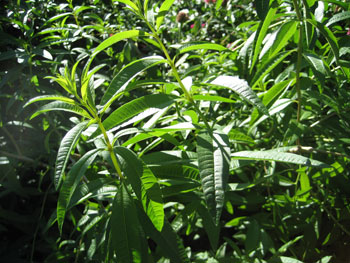
If this spice had a less cumbersome name—say, methi, its common commercial name (and what it’s called in India)—it might be better known and more popular in the Western world; as it is, it’s a rare curiosity, which is a shame.
Fenugreek is grown both for its seeds, which are lightly roasted before use in cooking, and for greens. It is mainly an Indian spice, much used in curries, but its use extends to the eastern Mediterranean areas, where it turns up in Egyptian and Greek dishes. As seeds, it is always used lightly roasted—roasting brings out its characteristic somewhat bitter taste, which is always an accent or background taste where this spice is called for, but over-roasting makes it too bitter. There is no doubt that if it were better known in the West, many and many a use for it could be found by inventive cooks, as numerous posts to the internet demonstrate. (A flavor resemblance sometimes mentioned with fenugreek seed is maple, as in maple syrup, which we have noted ourselves—it is even used to make imitation maple syrups.)
Fenugreek also has beneficial effects in reducing the effective glycemic index of other foods, and even in lowering cholesterol [Click through the disclaimer to read the article.].
As with many herbs, lore ascribes many other potencies to it; a commonly believed one is that it augments lactation in nursing mothers.
As to iys uses as greens, Tom Stobart, whose herb and spice book we strongly recommend, writes that:
If fenugreek seed is sown in boxes [planters] and grown to the two-leaf (cotyledon) stage like mustard and cress, it makes a five-star salad when dressed with oil and vinegar. The taste is refreshing, new and unusual.
Stobart notes, though, that mature fenugreek greens are quite bitter—but says that curried, even they make a satisfactory dish. But in any event, fenugreek can also be grown as “micro-greens” for salads and such.
Cultivars
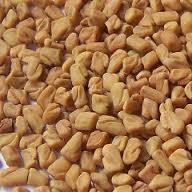
It must prove something that there are numerous well-known cultivars of fenugreek in use in the extensive commercial trade, but no named varieties whatever (that we could find) in the home-garden seed catalogues; few enough carry even a generic “fenugreek“.
Planting
Timing
Fenugreek likes warmth: its growth is slow and weak in cold temperatures or wet soils. Since it supposedly bolts to seed quickly and easily, we might as well plant it out when the weather has gotten good and warm, say middle May, or even June 1st.
The Bed
The general rule for herb and spice plants is that their soil needs are not demanding, save that the soil must be very well-drained: few herb or spice plants can stand “wet feet“. The soil should not be particularly rich, most especially not for flavoring plants we grow for their seed (or fruit), common mis-advice to the contrary notwithstanding: a rich soil will lower the concentration of the “aromatic oils“ that give the seed its characteristic flavor, which is the very thing we are growing them for. Plants that are slightly nutrient-stressed (which doesn’t mean starved) give better-tasting seed.
Fenugreek is typical of that description.
Fenugreek can also be grown in containers—or, for micro-greens, in trays. They sprout quickly, and a tray of them for that use can be easily grown.
Planting Out
Curiously, fenugreek is a legume; it will thus enrich the soil where it is grown, but that also means it’s wise to use inoculant (of the usual pea-and-bean sort) on it when seeding.
Plant seed where the plants are to grow; seed about ¼" deep. Some sources recommend pre-soaking the seeds in warm water for half a day or so. Spacing is unclear, but apparently it is usually grown closely—at 2 to 4 inches apart.
Indeed, some sources recommend it as a ground cover for areas where other, larger, wider-separated vegetables grow: you get a useful crop while holding down weeds.
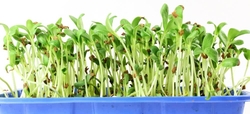
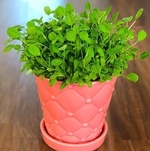
Or you can take a fairly shallow tray (or bowl), partly fill it with potting soil, scatter seed thickly, dust a little more soil over to cover, and water (preferably with a mister). Be sure to keep the soil moist but not waterlogged. When the sprouts are a couple of inches high, harvest and start over. They grow quite rapidly. (Or you can use a conventional pot, but a tray gives you lots more surface area.)
Growing
The seeds—brownish, about 1/8 inch long, oblong, rhomboidal, with a deep furrow dividing them into two unequal lobes—are contained, 10 to 20 together, in long, narrow, sickle-like pods, which do not naturally shatter. For seeds, then, fenugreek plants may be left to dry down, then harvested. The seeds, like most spice seeds, need to be very well dried, but never with any sort of warm-air or forced drying, lest they lose some essential oils.
Relevant Links
Besides any links presented above on this page, the following ought to be especially helpful.
Return to the top of this page.
If you find this site interesting or useful, please link to it on your site by cutting and pasting this HTML:
The <a href="https://growingtaste.com/"><b>Growing Taste</b></a> Vegetable-Gardening Site
—Site Directory—
Search this site, or the web
-
Background Information
about the purposes and design of this site
- Site Front Page
-
Introduction
- An Apologia: why one should cultivate one's garden
- Deep-Bed Gardening (forthcoming)
- Container Gardening (forthcoming)
- Vegetarian and Organic Considerations (forthcoming)
-
Recommended Crops for a home garden, by variety
-
Gardening information and aids
-
Miscellaneous Information of interest to the home gardener
Since you're growing your own vegetables and fruits, shouldn't you be cooking them in the best way possible?
Visit The Induction Site to find out what that best way is!
|
If you like good-tasting food, perhaps you are interested in good-tasting wines as well?
Visit That Useful Wine Site for advice and recommendations for both novices and experts.
|

|
This site is one of The Owlcroft Company family of web sites. Please click on the link (or the owl)
to see a menu of our other diverse user-friendly, helpful sites.
|
|
 Like all our sites, this one is hosted at the highly regarded Pair Networks,
whom we strongly recommend. We invite you to click on the Pair link for more information on getting your site or sites hosted on a first-class service.
Like all our sites, this one is hosted at the highly regarded Pair Networks,
whom we strongly recommend. We invite you to click on the Pair link for more information on getting your site or sites hosted on a first-class service.
|
|
All Owlcroft systems run on Ubuntu Linux and we heartily recommend it to everyone—click on the link for more information.
|
Click here to send us email.
Because we believe in inter-operability, we have taken the trouble to assure that
this web page is 100% compliant with the World Wide Web Consortium's
XHTML Protocol v1.0 (Transitional).
You can click on the logo below to test this page!
You loaded this page on
Saturday, 27 April 2024, at 00:36 EDT.
It was last modified on Monday, 10 January 2022, at 05:10 EST.
All content copyright ©1999 - 2024 by
The Owlcroft Company