Owing to the screen size of your device, you may obtain a better viewing experience by
rotating your device a quarter-turn (to get the so-called "panorama" screen view).
|
This page updated for 2022.
|
Click here for the site directory.
|
|
Please consider linking to this site!
|
Click here to email us.
|
Brussels Sprouts
(Brassica oleracea gemmifera)
Cultivars
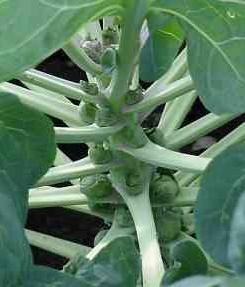
A vegetable unjustly disdained by those who know only the tough, bitter, overgrown junk available in the supermarkets (well, arguably it is just for such folk to disdain it), it should thrive in our locale, though timing is the key to success. The species likes a fairly long growing season that is cool when the sprouts themselves start to develop (indeed, like many cool-weather crops, it actually needs some frosting to attain its proper flavor).
Also: whatever you do, don’t prepare them by boiling them; roast them, stir-fry them, braise them—just don’t go all English-cooking (”boil ’em till they surrender”) with them.
This is another item with a fairly large number of variants, each—as always—being “the best,” according to the seedsmen. If we try to use the invaluable Cornell “Vegetable Varieties for Gardeners” database, we find several candidates, but…almost none seem available in today’s seed market. If we go the other way round and see what seedsmen are offering, we find virtually zero information or comment from anyone not trying to sell their selections. So what to do?
It turns out that there is one variety that is both well received and widely available—and it’s an open-pollinated one. So, if you don’t want to gamble on the accuracy of seedsmens’ claims, your choice should be Long Island Improved.
Planting
First, and always with any brassica crop: Remember to rotate your crops! Planting Brassicas, of any kinds, in the same ground more often than once every four years runs the risk of clubroot infestation—and once you get that, the ground is useless for up to a decade. Don’t take needless chances, even with “catch crops” of radishes.
We will repeat here what we now say about all Brassicas. For a long time, we made the mistake many amateur Brassica growers make, that of trying to race against summer with cool-weather crops. Even with fairly early plantings, if the crops don’t mature very quickly, the weather gets warm then hot, and your sprouts (or other Brassica) crop is largely or wholly shot.
The answer, especially in this era of continuous global warming, is easy: because all Brassicas are quite tolerant of rather cool to cold weather (some actually need some frosting to achieve peak flavor), one simply plants the seeds in mid to late summer and harvests in late fall or even early winter. If the plants don’t grow as fast as we might like, no harm done because they can withstand the cool/cold weather of late fall and early winter.
Timing
A lot of sources insist that sprouts should be started indoors as seedlings. But they are talking about spring-planted sprouts, which, as we said above, seems a useless fight against nature. If we are summer-planting for late-autumn harvest, for us the seeds will go in the ground in early August, which is scarcely a time when one worries about poor l’il seedlings getting frosted down. So, obviously, we direct-sow.
For our exact climate, one could seed on or about August 1st. The nice thing about fall harvest is that we don’t need to be too exact about dates, because the plants can go pretty deep into autumn and early winter. Long Island Improved is usually listed as 100 days, but fall-planted could take a week or two more; that means harvest should be able to start around Thanksgiving (at latest)…but we can keep going on till, well, till almost forever. One source says “In colder climates, Brussels sprout plants should be pulled out of the soil before temps drop below 10 degrees F. in the late fall”—but our average overnight low never gets that low (again, average low); another source said “I let some Brassicas overwinter last year and all of them lived through several nights in the teens and highs below freezing”; and tales of gardeners stomping through snow drifts to pick sprouts are common. What a change from spring planting!
Sowing Seed
Plant seed ¼ to ½ inch deep. These fellows need some room: even in a deep-dug bed, an 18" spacing is wanted. Be sure to plant a few seeds at each spot, then thin to the hardiest as they come up.
The Bed
Brussels sprouts are generally treated like broccoli or cauliflower and suchlike brassicas. They are largely indifferent to soil type (from sand to clay), though they do need well-drained soil. But: Several sources suggest planting in soil that has not been enriched with any nitrogen source (apparently, sprouts in high-nitrogen soils grow gangbusters, but are too busy leafing and stemming to bother setting sprouts).
Growing
They want regular and generous watering (brassicas in general like having wet leaves, so water freely).
Again: Keep firmly in mind that sprouts that have not been exposed to one or more pretty solid freezes are nearly tasteless. This is most definitely a late fall—or even winter—crop! Keep it going as long as you can—it might well continue bearing right through the winter, snows and all.
If any of the lower leaves of the plant show any yellowing, at once strip them off. (By the way: the younger, tender leaves can be cooked up much like collards or turnip greens, if that’s your idea of a good time.)
Also, be sure to keep an eye out for signs of insect attack. If you see ants on a plant, that signifies aphids; blow them off with a jet of water at as high a blast as hard as you can without actually damaging the plant.
Commercial gardeners remove all leaves to accelerate harvest, but that practice is not essential in the home garden. Some gardeners believe that the sprouts develop better if the lowermost six to eight leaves are removed from the sides of the stalk as the sprouts develop. Two or three additional leaves can be removed each week, but several of the largest, healthiest, fully expanded upper leaves should always be left intact on top to continue feeding the plant.
Another commercial practice is “topping”—pinching off the growing tip of the plant when the sprouts are present but immature. Some sources say that is not critical for home growers, but others swear that it is utterly essential for good production. If you want to go that route, figure on doing the topping about three weeks before your harvest is to begin; for us, that would be around the first of November.
Once plants begin to set sprouts, they can become a bit top-heavy and could be prone to wind damage (or even be blown over). Many suggest staking the plants or hilling up soil around the stems to support them; we, who get very high winds at times, have never had any problem with unstaked plants, but there it is.
As the sprouts come ready, harvest them from the bottom up, which is how they mature (the all-at-once harvesting of agribusiness is one reason store-bought samples taste so bad). Keep them picked—they’ll grow
more.
More
Relevant Links
Besides any links presented above on this page, the following ought to be especially helpful.
Odds and Ends
Biology
It is a brassica, a member of the Cruciferae, closely related to cabbages, and nearly as closely to broccoli and cauliflower.
History
Though sprouts were cultivated in Italy in Roman times, and in some form by possibly as early as the 1200s in Belgium. Brussels sprouts in the form that we are familiar with today were first cultivated in large quantities in Belgium (hence the name “Brussels” sprouts) starting somewhere around 1587.
Brussels sprouts were introduced into the U.S. in the 1800s. By the 1900s, they were being grown commercially in California.
Envoi
We couldn’t decidee which of the following factoids (gleaned from Eric Hunt’s 10 things you didn’t know about Brussels sprouts page), so we give the lot:
- The heaviest recorded Brussels sprout was 8.3 kg [over 18 pounds!]. This massive sprout was grown in Llanharry, Wales in 1992 by Bernard Lavery.
- The record for the most number of Brussels sprouts eaten in one minute is 31. This record is held by Linus Urbanec from Sweden.
- Brussel sprouts can power batteries. In 2013, a battery made of 1000 sprouts generated 63 volts, which were used to light up an eight-foot Christmas tree in Southbank, London.
- Brussels sprouts taste awful to people with TAS2R38 gene. The gene encodes a receptor that allows detection of the bitter compounds called glucosinolates found in Brassica species.
Oh, and Brussels sprouts are the 23rd most-popular vegetable in New Zealand.
Return to the top of this page.
If you find this site interesting or useful, please link to it on your site by cutting and pasting this HTML:
The <a href="https://growingtaste.com/"><b>Growing Taste</b></a> Vegetable-Gardening Site
—Site Directory—
Search this site, or the web
-
Background Information
about the purposes and design of this site
- Site Front Page
-
Introduction
- An Apologia: why one should cultivate one's garden
- Deep-Bed Gardening (forthcoming)
- Container Gardening (forthcoming)
- Vegetarian and Organic Considerations (forthcoming)
-
Recommended Crops for a home garden, by variety
-
Gardening information and aids
-
Miscellaneous Information of interest to the home gardener
Since you're growing your own vegetables and fruits, shouldn't you be cooking them in the best way possible?
Visit The Induction Site to find out what that best way is!
|
If you like good-tasting food, perhaps you are interested in good-tasting wines as well?
Visit That Useful Wine Site for advice and recommendations for both novices and experts.
|

|
This site is one of The Owlcroft Company family of web sites. Please click on the link (or the owl)
to see a menu of our other diverse user-friendly, helpful sites.
|
|
 Like all our sites, this one is hosted at the highly regarded Pair Networks,
whom we strongly recommend. We invite you to click on the Pair link for more information on getting your site or sites hosted on a first-class service.
Like all our sites, this one is hosted at the highly regarded Pair Networks,
whom we strongly recommend. We invite you to click on the Pair link for more information on getting your site or sites hosted on a first-class service.
|
|
All Owlcroft systems run on Ubuntu Linux and we heartily recommend it to everyone—click on the link for more information.
|
Click here to send us email.
Because we believe in inter-operability, we have taken the trouble to assure that
this web page is 100% compliant with the World Wide Web Consortium's
XHTML Protocol v1.0 (Transitional).
You can click on the logo below to test this page!
You loaded this page on
Friday, 26 April 2024, at 20:46 EDT.
It was last modified on Friday, 24 December 2021, at 14:40 EST.
All content copyright ©1999 - 2024 by
The Owlcroft Company