Owing to the screen size of your device, you may obtain a better viewing experience by
rotating your device a quarter-turn (to get the so-called "panorama" screen view).
|
This page updated for 2022.
|
Click here for the site directory.
|
|
Please consider linking to this site!
|
Click here to email us.
|
Garlic
(Allium sp.)
Cultivars
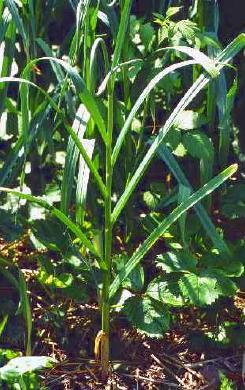
There is a charming poster that shows a full-color closeup of a few cloves of garlic; it is labelled “Italian caviar,” and that sums up garlic excellently. Garlic qualifies as a great vegetable because not only is it an indispensible cookery ingredient, it can well and delightfully be eaten as and for itself (squeeze the paste from roasted garlic out on some lightly toasted French/Italian bread, pop a young, slightly acidic red wine, and preview Paradise).
Aficionados of garlic cultivars are perhaps not as vociferous as chileheads or tomato fanciers, but we daresay they rank ahead of even corn advocates. Making particular choices from the wealth of available possibilities is difficult. We are fortunate in that there is a garlic specialist—Filaree Farm—in our, as they put it, “eco-region”; we thus have, at the least, a good basis for believing that the types we select will grow well here. (In much of the information on this page, we are closely following Filaree’s helpful combination catalogue/guide.)
There are a myriad types of garlic. They can be classed in hierarchies, the top levels of which have some botanical significance and the lower levels of which are more expert experience than botany (at least so far—the field is still advancing). The critical factors in selecting even classes of interest are two: taste, and storage ability (for there is no point in growing a year’s supply of a kind that only keeps for a few months). Suitability for growing is third by so much that it scarcely figures in out here; to the minimal extent that it does, it would be to eliminate that class called “Creole” garlics, which “perform best in mild-winter and southern climates”. Here, then, are the key data.
Classes and Flavor
The highest-level divisions are “hardneck”, “softneck”, and a class some call “weakly-bolting hardneck” (see the discussion down the page under “Biology”).
Very broadly speaking, hardnecks have more intense flavors—they are more closely related to their wild ancestor—but lesser storage capabilities, while conversely softnecks are excellent “keepers” but usually much milder. (That is a broad-brush simplification with numerous exceptions and half-exceptions.) The “weakly-bolting hardneck” types often produce softnecks, and are best suited for warm to hot Southern climates.
There are three main subdivisions of hardnecks (“rocambole”, “porcelain”, and purple stripe“), and two of softnecks (”artichoke“ and “silverskin”); some have further subdivisions. Here are those divisions, with notes (from Filaree Farm) on their typical storage capabilities:
- Softneck:
- Artichoke (keeps c. 10 months)
- Silverskin (keeps c. 10 to 12 months)
- Weakly-Bolting Hardneck:
- Asiatic (keeps c. 4 months)
- Creole (keeps c. 10 to 12 months)
- Turban (keeps c. 4 months)
- Hardneck:
- Purple Stripe types:
- Purple Stripe (keeps c. 4 to 6 months)
- Glazed Purple Stripe (keeps c. 4 to 6 months)
- Marbled Purple Stripe (keeps c. 4 to 6 months)
- Porcelain (keeps c. 6 months)
- Rocambole (keeps c. 4 to 6 months)
Some Conclusions
In our climate, we can at once strike off the weakly-bolting hardneck types. Next we have to weigh the significance of storage ability versus flavor: the hardnecks are really the ones for deep, true garlic taste (taste being what this site is all about), and also not many people have the ideal storage facilities for keeping garlic many months. So we strike off all the softnecks.
Lest that seem over-hasty, let us add that if one grows garlic in a barrel or tub or other large container, it is possible to have garlic a) virtually year round, and b) have it as virtually perennial—thus storage ability scarcely matters. We’ll get into all that a little farther on.
That leaves us the hardnecks: three types, one with three subdivisions. (Mind, within each type there are many varieties.) Let’s look at those more closely.
Rocambole
These produce large, easily peeled cloves with fine flavor.
Porcelain
Most Porcelains have only 4 to 6 symmetrical cloves per bulb, though those cloves are often as large as unshelled Brazil nuts (and are frequently mistaken for elephant garlic). Their flavor is outstanding, rivaling that of Rocamboles.
Purple Stripe Types
Standard Purple Stripe
These are very flavorful, usually winning “best baked garlic” taste tests conducted by Rodale, Sunset Magazine, Martha Stewart, and others.
Glazed Purple Stripe
The cloves are not as tall and elongated as standard Purple Stripes, and there are fewer cloves per bulb. They mature slightly sooner than standard Purple Stripes.
Marbled Purple Stripe
Most strains have only 4 to 7 cloves per bulb. The bulbs appear to display characteristics of both Rocamboles and Purple Stripes.
So, it looks to us like the Standard Purple Stripe is the type we want. But within that type, there are, as we said, still numerous particular varieties (each with its fervent partisans). At this point, the variety-selection process becomes more subjective.
The type we opt for is the well-known Chesnok Red (sometimes also listed as “Shvelisi”, its town of origin), said by many to be both one of (or the) most productive but also the most intensely and pleasingly flavorful.
There: wasn’t that easy?
Planting
Before we get on to the details, let us say that we have become very interested in a growing (no pun intended) trend: treating garlic as, in effect, a perennial. There are lots of pages on how to grow garlic as a perennial, but the essence of it is that you plant and grow as usual, but re-plant part of your harvest for the next season. That’s an over-simplification, but read a few of the pages that link will show you to get details. We will point out the differences in methods as we go into the details below.
Timing
Look at enough pages on growing garlic and you soon realize that a key datum is the approximate date you can expect the ground to freeze: lots of timing advice uses that date as its reference point. (Mind, the “ground” never “freezes”—soil is a solid—it is the water in the ground that freezes.) To reckon that date in your climate, figure that it takes five or more days of sub-freezing air temperatures (day and night) before the ground freezes solid.
In our climate, that would usually occur sometime in early to middle December. You need to check your climate records—personally kept or, lacking that, from local weather records.
Once you have reckoned that date, subtract about two to four weeks to get your planting date. (Garlic supposedly can be planted any time before the ground freezes solid, but a few weeks earlier allows the cloves to establish some roots while minimizing the amount of top growth prior to winter.) If we use three weeks and take December 10th as the ground-freeze date, that givesNovember 19th (give or take a week) as the sowing date. Your dates may be different, but the point here is to show you how to reckon those dates from hard data instead of hand-wave general advice.
The Bed
Garlic wants a sunny spot. The soil should be rich (but not too rich, or the tops will overdevelop at the expense of the bulbs). Garlic does not do well in really sandy or really clay-ey soils, or soils lacking in organic matter; the soil should be loamy, and well-drained.
While one can add soil amendments, there’s usually little one can do about excesses already present. Still, research has shown that high phosphorous levels can decrease plant height, average bulb weight, and usable yield, so keep that in mind.
Planting Out
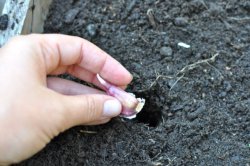
Obviously, one always plants garlic where it is to grow.
Plant individual cloves with the root end down—be sure you don’t set them upside-down! The “pointy” end goes up—the flat end goes down! Set them an inch or two deep. Mulch them as soon as they are planted; compost, aged manure, or weed-free hay or straw would work well. Some sources say to set them 6 inches apart; others—deep-bed sources—suggest that 4 inches will suffice, but to us that seems like crowding. Obvious, but probably worth saying anyway: large cloves will produce large bulbs, and small ones, small; save the smaller cloves from your seed bulbs (usually the interior ones) for kitchen use and re-plant only the larger ones.
Growing
Garlic is pretty winter hardy, but it can be damaged by a combination of very cold temperatures and a thin snow cover. If such conditions arise, or seem likely to, cover your garlic with a mulch as described above (a very good idea in any case).
In the spring, the garlics will send up greens through the mulch. When those emerge, begin watering them, more or less like any garden green. If you can apply some extra nitrogen at this time, so much the better.
Somewhere around mid-May, the garlics will finish their green-growth stage and start bulbing up. Around that time you can slightly cut back their watering.
Vital note! Hardneck types—which we strenuously recommend—will, somewhere around early June, send up a flower stalk: keep a close eye on it. About a week after those stalks begin to uncoil, turn woody, and stand upright, cut the stalks off about ½ inch above the top plant leaf. Fail in that, and you’ll get little if any bulb. And note that those scapes make a tasty dish themselves.
When the leaves start turning from green to brown, their growth period is about over. At that time, keep watering minimal: the topsoil should not be really wet, or the bulbs may mold, or at least stain.
Here is the point at which the perennial approach differs from the annual.
Growing As An Annual Crop
You harvest all the garlics at this point; opinions vary about exactly when to strike, but expert consensus seems to be soon after half or so of the leaves have gone brown. Do not wait for most or all of the leaves to go brown.
Harvest by simply taking the bulbs out of the ground. Do not leave freshly dug bulbs in direct sunlight for more than a very few minutes—they will more or less cook. Hang dug bulbs somewhere indoors and let them cure—two or three weeks is probably what that will take in our climate. When curing is satisfactorily complete, the neck of the plant can be cut about ½ inch above the bulb without any moisture showing (if you try it and detect moisture, curing is not complete). Cured garlics can be neck- and root-trimmed and stored in hanging net bags (like onions).
Growing As A Perennial Crop
Here is information from Ashley Adamant at the Practical Self Reliance site (which you ought to visit—these are just illustrative highlights from that page):
“In the care of annual garlic, [the scapes] really must be removed, or the bulbs will be small. [But] when garlic is perennial, there is no rush whatsoever to get the scapes off, because they eventually yield the best harvest of all: the bulbils.
“Garlics, unlike the conglomerate of perennial leeks, don’t bloom, but rather make little bulbs en mass atop their stem. These burst their papery wrapping, perfect for harvest in early July for me [in Vermont] – about the time I [would] have to dig the bulbs of annual garlic. I prefer the bulblets though. They have a milder flavor, and are very tender. No peeling necessary for these but peeling back the outer paper that covers the clump as a whole.
“These bulbils are delicious when broken up and sautéed in butter to flavor whatever dish that could use a vibrant flush of garlic.
For winter garlic, I pick out one of these clumps of perennial garlic each spring or fall and divide it up. A single bundle will have many individual garlic cloves, and once they’re divided out they’ll grow into full-sized garlic bulbs for harvest the following July. Simply use a shovel to dig up the whole clump, making sure there’s plenty of dirt intact around the root ball. Carefully separate the individual garlic plants, and plant them deep in fertile soil. Since there’s already a green top growing from each garlic bulb, you’ll need to be careful not to damage them in planting. This patch of curing garlic will also need scapes cut to mature properly. (In truth, the ‘cured’ garlic for winter use is still being grown as an annual: up here in Vermont it gets way too cold to dig garlic outdoors in February.) ”
Take care when you harvest scapes not to take them all; leave a sufficiency. When fall arrives, the scapes will set little bulbils (bulblets) at their tips. Those bulblets will then dry down into miniature garlic cloves. You use those as your “seeds” for next year’s crop (which is why you need to have left a sufficiency of scapes intact). If you have left enough scapes, you’ll likely have more bulbils than you need for re-planting; those you can use as you would regular garlic cloves.
So that’s it: plant in the fall at your calculated sowing date, harvest some scapes in the warmer months of the following year, harvest some cloves in the fall for your culinary use through the winter, re-plant the bulbs at your sowing date. Lather, rinse, repeat: garlic all year round, forever.
More
Relevant Links
Besides any links presented above on this page, the following ought to be especially helpful:
Odds and Ends
Biology
Modern garlics are of only two species: Allium ophioscorodon, the “hardnecks”, which produce a flower stalk as did their wild ancestor; and A. sativum, the softnecks, which usually do not produce a flower stalk. The softnecks did not arise in nature: they are a result of breeding work to lengthen storage time (at the expense of intensity and quality of flavor).
The Allium genus is part of the Liliaceae, the lily family—which includes onions, leeks, and asparagus among its more useful edible members.
History
Let’s not re-invent the wheel: this USDA site (also linked above) covers the ground.
Envoi
“Goot eeevening; I am Count Dracula—velcome to my castle.”
“Buddy, you’re sick.”
Return to the top of this page.
If you find this site interesting or useful, please link to it on your site by cutting and pasting this HTML:
The <a href="https://growingtaste.com/"><b>Growing Taste</b></a> Vegetable-Gardening Site
—Site Directory—
Search this site, or the web
-
Background Information
about the purposes and design of this site
- Site Front Page
-
Introduction
- An Apologia: why one should cultivate one's garden
- Deep-Bed Gardening (forthcoming)
- Container Gardening (forthcoming)
- Vegetarian and Organic Considerations (forthcoming)
-
Recommended Crops for a home garden, by variety
-
Gardening information and aids
-
Miscellaneous Information of interest to the home gardener
Since you're growing your own vegetables and fruits, shouldn't you be cooking them in the best way possible?
Visit The Induction Site to find out what that best way is!
|
If you like good-tasting food, perhaps you are interested in good-tasting wines as well?
Visit That Useful Wine Site for advice and recommendations for both novices and experts.
|

|
This site is one of The Owlcroft Company family of web sites. Please click on the link (or the owl)
to see a menu of our other diverse user-friendly, helpful sites.
|
|
 Like all our sites, this one is hosted at the highly regarded Pair Networks,
whom we strongly recommend. We invite you to click on the Pair link for more information on getting your site or sites hosted on a first-class service.
Like all our sites, this one is hosted at the highly regarded Pair Networks,
whom we strongly recommend. We invite you to click on the Pair link for more information on getting your site or sites hosted on a first-class service.
|
|
All Owlcroft systems run on Ubuntu Linux and we heartily recommend it to everyone—click on the link for more information.
|
Click here to send us email.
Because we believe in inter-operability, we have taken the trouble to assure that
this web page is 100% compliant with the World Wide Web Consortium's
XHTML Protocol v1.0 (Transitional).
You can click on the logo below to test this page!
You loaded this page on
Saturday, 27 April 2024, at 00:47 EDT.
It was last modified on Wednesday, 26 January 2022, at 01:59 EST.
All content copyright ©1999 - 2024 by
The Owlcroft Company