Owing to the screen size of your device, you may obtain a better viewing experience by
rotating your device a quarter-turn (to get the so-called "panorama" screen view).
|
This page updated for 2022.
|
Click here for the site directory.
|
|
Please consider linking to this site!
|
Click here to email us.
|
Kale
(Brassica oleracea)
The taste of kale is rather strong, and characteristic of the Brassicas; its chief traditional use—like that of so many Brassicas—was as a winter vegetable, for it can, in many climates, literally grow up through the snow. We have found it, even at its home-grown best, rather coarse as to both texture—“chewy” as one gardener describes it—and flavor, and had given up on it, there being too many better greens for culinary use. But a new variety—a perennial!—seems worth trying, and we will do that this season.
Cultivars
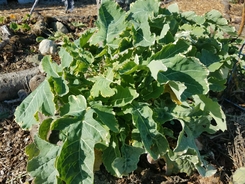
“Perennial” kales are not new, but the cultivar Kosmic Kale is. Besides being perennial, and producing year round, it is reportedly nontrivially better eating than the usual kales (follow the link in this sentence).
(Some gardeners believe that Kosmic Kale is really an older U.K. variety called “Daubenton’s”, just given a sexy new name. That appears to be incorrect: it was introduced to the U.S. by Log House Plants in Oregon, and was bred by Dick Degenhardt in Boskoop, Netherlands. Mind, Daubenton might be in its ancestry.)
Kale, as a Brassica, cannot be grown in the same soil any more often than once every four years (else there is a serious clubroot infection risk). But with a perennial, you just pick your spot, plant it, and that’s that.
(There is now a new plant closely related to kale and trade-named Kalettes [also known as “Lollipops”]. It is a conventionaslly bred cross between kale and Brussels sprouts, looking like sprouts but with mini-kales instead of the sprouts.) The Toronto Star said of them, “They’re milder than brussels sprouts and more tender than kale, which are both members of the cabbage family. Some people describe them as sweet and nutty.” We’ll wait and see what reaction actual home gardeners have as time goes by. See also How to Cook Kalettes.)
Planting
Timing
Because Kosmic Kale, as a perennial, does not set seed, one buys it as a transplant, and puts it in the ground as soon after it arrives as possible (“possible” here means after a hardening-off period, the usual being a week or so). It is OK to plant out in warmth, so we ticket the transplant for arrival in the second half of May (along with our warm-weather-crop transplants), so it’ll go in near the first of June, which matches up with general recommendations.
The Bed
Like most cole crops (except cauliflower), kale is fairly indifferent to soil type and pH, but does want well-drained soil; some sources say coles prefer a slightly alkaline soil, a hair over 7.0, but most any decent garden soil should do. Coles are also said to prefer a “heavy” soil, so—within reasonable bounds—clay is not a problem. And while they are reputedly not fussy about needing direct sun, direct sun is how they grow best. They like soil with plenty of calcium (old-timers used to enrich the soil with crushed eggshells).
Note that Kosmic Kale can grow quite large. It would be wise to allot a 3' x 3' or even 4' x 4' space for it (though you can, of course, cut it back to smaller sizes).
Growing
Water as needed—about as you would cabbage. (Some sources say water infrequently but deeply.) Do not apply extra fertilizer: excess nitrogen will cause sappy—and thus frost-sensitive—tissue.
Whenever the plant seems well established, you can being harvesting leaves on the “cut and come again“ basis. Cut leaves from the bottom of the plant up. Note that as with most or all Brassicas, cold weather, and especially frosts, brings out the best flavor. Also, while it can be harvested during the first year, be sure to leave enough leaves to keep the plant growing—don’t harvest all the leaves at once.
Kosmic is said to be cold-hardy down to about 10°F. Our average lowest overnight low never gets to that (it’s about 16°), but we (and, we suppose, you) will inevitably get some cold snaps that go below that 10°. The Kosmic will probably survive well below that nominal 10° if the snap doesn’t last too long—but it will certainly help to mulch fairly deep in winetr with straw or hay or the like. (And if your local forecast shows a deep cold coming on, try tricks like putting plastic bottles of hot water around the plant.)
More
Relevant Links
Besides any links presented above on this page, the following ought to also be helpful:
Odds and Ends
Biology
What is collectively called “kale“ by gardeners encompasses two species (Brassica napus and B. oleracea, each of which has several races (subspecies), making a total of ten members of the genus Brassica (family Cruciferae) that are usually called “kale“; the Plants for a Future “kale“ page details the list (and there are a few non-Brassica crucifers not far off, such as “seakale“, Crambe cordifolia). The full picture can be confusing.
B. oleracea was the wild ancestor of cabbage, broccoli, brussels sprouts, kohlrabi, and cauliflower; it arose along the Atlantic and Mediterranean coasts of Europe. Today, there are at least a half dozen recognized races of B. oleracea, such as Brassica oleracea Alboglabra (which includes the white-flowered Chinese kale, native to Southeast Asia).
The other “kale“ genus is B. napus; that—to complicate matters—also takes in not only such things as the noted “Red Russian“ and “White Russian“ kale, but also what gardeners commonly call rutabagas (or “Swedes“ or “Swede turnips“) as well as rape (now often, for social reasons, called canola), from which a valuable oil is commercially extracted; the genus is today widely adapted throughout northern Eurasia, though its region of origin is unknown.
History
The old, original Brassica oleracea ancestor is native to the Mediterranean region of Europe, and is somewhat similar in appearance to a leafy canola plant. Sometime soon after the first domestication of plants, that ancestral plant was being grown as a leafy vegetable around the Mediterranean. Because the leaves were the part of the plant consumed, those plants with the largest leaves were selectively propagated for next year’s crop.
By the 5th century B.C., that continued preference for ever-larger leaves led to the vegetable we now know as kale (known botanically as Brassica oleracea acephala, “headless cabbage“). Eventually, the other cole crops familiar today, from cabbage to Brussels sprouts, were bred out of kale.
Envoi
Today, seemingly out of nowhere, kale has become a hot item. Why? How? It’s a fascinating story.
Return to the top of this page.
If you find this site interesting or useful, please link to it on your site by cutting and pasting this HTML:
The <a href="https://growingtaste.com/"><b>Growing Taste</b></a> Vegetable-Gardening Site
—Site Directory—
Search this site, or the web
-
Background Information
about the purposes and design of this site
- Site Front Page
-
Introduction
- An Apologia: why one should cultivate one's garden
- Deep-Bed Gardening (forthcoming)
- Container Gardening (forthcoming)
- Vegetarian and Organic Considerations (forthcoming)
-
Recommended Crops for a home garden, by variety
-
Gardening information and aids
-
Miscellaneous Information of interest to the home gardener
Since you're growing your own vegetables and fruits, shouldn't you be cooking them in the best way possible?
Visit The Induction Site to find out what that best way is!
|
If you like good-tasting food, perhaps you are interested in good-tasting wines as well?
Visit That Useful Wine Site for advice and recommendations for both novices and experts.
|

|
This site is one of The Owlcroft Company family of web sites. Please click on the link (or the owl)
to see a menu of our other diverse user-friendly, helpful sites.
|
|
 Like all our sites, this one is hosted at the highly regarded Pair Networks,
whom we strongly recommend. We invite you to click on the Pair link for more information on getting your site or sites hosted on a first-class service.
Like all our sites, this one is hosted at the highly regarded Pair Networks,
whom we strongly recommend. We invite you to click on the Pair link for more information on getting your site or sites hosted on a first-class service.
|
|
All Owlcroft systems run on Ubuntu Linux and we heartily recommend it to everyone—click on the link for more information.
|
Click here to send us email.
Because we believe in inter-operability, we have taken the trouble to assure that
this web page is 100% compliant with the World Wide Web Consortium's
XHTML Protocol v1.0 (Transitional).
You can click on the logo below to test this page!
You loaded this page on
Friday, 26 April 2024, at 03:54 EDT.
It was last modified on Friday, 31 December 2021, at 18:58 EST.
All content copyright ©1999 - 2024 by
The Owlcroft Company