Owing to the screen size of your device, you may obtain a better viewing experience by
rotating your device a quarter-turn (to get the so-called "panorama" screen view).
|
This page updated for 2022.
|
Click here for the site directory.
|
|
Please consider linking to this site!
|
Click here to email us.
|
Okra
(Abelmoschus esculentus)
Cultivars
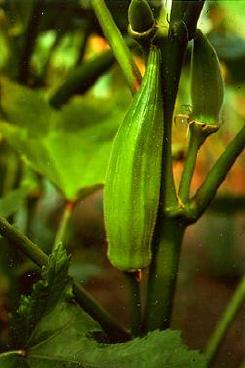
This very fine (nearly great) vegetable is shamelessly slandered by folk who don’t understand its cooking qualities. Yes, okra rapidly goes gooey when cooked with water: but, as they say in computertalk, that’s a feature, not a bug. That mucilagenous quality is prized by those who appreciate its uses in gumbo, wherein it thickens up the soup considerably while adding good flavor. But the best way to enjoy okra properly—and without any gooeyness—is the old Southern way: coated with cornmeal batter and fried quick and deep. Ummm, ummm, good!
Of all the vegetables on our lists, this out-of-Africa heat-lover is doubtless the most challenging in this climate, to the extent that it is probably not worth trying. Here are a couple of representative quotations from experienced northern-region gardeners:
“It’s not so much the DTM that’s the problem in a northern garden, but the cooler nights. Okra needs lots of heat and not just during the daytime. I’ve grown it and gotten a few pods but in my garden its more of a novelty than a productive crop.”
“Okra is a heat lover, and is very intolerant of cool temperatures, even for a short period. It is very susceptible to wilt if exposed to cool weather, and once infected, the plant will begin to die even if warm weather returns.”
Note also that okra grows very tall: 8', 10', 12', even to 15'. That presents its own set of problems if your area happens to be windy in the summer.
If, nonetheless, you want to try growing okra in a northern climate, the varieties most frequently mentioned by experienced gardeners as possibilities for such climates are Burmese, Pentagreen, and Emerald. The Burmese is a dwarf okra (typically tops out at about 3'), which is the sort most likely to succeed in short-season areas, but others have said that Pentagreen is the only successful one for them. Emerald is a generally recommended type sometimes said to do better than average in the north.
(If you happen to be in a less-challenging climate, the mosat frequently mentioned all-round good okras, besides the three mentioned above, include Stewarts Zeebest and Granny Franklin; the quite common “Clemson Spineless” is said to be productive, but very quick to get woody and tough.)
Not commonly stated in the literature (or catalogues) is that okra has daylength-sensitivity that varies with cultivar; most cultivars need a short daylength to initiate flowering, though there are also long-day and day-neutral cultivars. So “days to maturity” for a cultivar may not sufficiently define its usefulness—it should be explicitly labelled as suited for northern growing.
Like Will Rogers, we only know what we read in the newspapers (well, and articles). From the University of Arkansas publication “Okra Production Update for Small Acreage Growers”:
Flowering is day-length sensitive. Less than 11 hours promotes flowering in most cultivars. Under longer days, flowering buds tend to abort. However, “Clemson Spineless” is one of many cultivars that is not photo-period sensitive.
So there are “many” cultivars that are not daylength-sensitive—but some that are. We repeat that the safest bet is to use varieties stated as (by the seedsman or a number of experienced northern-region gardeners) as suited for northern growing.
Planting
Timing
When to plant out is critical in this climate. Avoiding too-cool nights is more of a problem than getting warm days (though both matter). Ideally, okra would like night-time lows of about 65, but we just don’t get temperatures like that. It is said that “Night temperatures should be above 55° F for good growth”, and that “Plants will stop growing as soon as the temperature starts dropping down below 50° F.”
Well out here our very highest average nightly low temperature for the year is only 50°: we see that number (again and always, on average) from late July to early August, a span of perhaps two weeks. Even early okra nominally takes—depending on whom you believe—about 50 to 65 days from transplant to maturity. If we call it 64 days, and recall that our peak heat comes around July 22nd, that suggests planting out around June 20th for harvest around August 23rd—a period when our average daily highs run from 80° at each end to 90° in the middle, which seems satisfactory. Anyway, we hope it’s satisfactory, because it’s the best we can do. (As one of the links farther below says, one grower in a tough climate direct-seeded some Clemson around the 1st of July more or less as a lark, and got surprisingly good results.)
One apparently wants to start okra seedlings about 4 to 5 weeks prior to anticipated plantout, which means sowing seed around May 23rd or perhaps even May 16th, a week earlier.
Starting Seedlings
The minimum soil temperature for okra seed germination is about 60° F., but the optimum germination temperature is 95° F. The temperature really makes a difference: at soil temperatures of about 60°, germination takes 27 days, whereas at about 75°, germination may take only 13 days, and in ideal conditions perhaps a week. Obviously, heat mats (electric “heating pads” for use under seedling trays) are a much-wanted tool here.
Okra is another of those plants that really, really doesn’t want its root system joggled about, so it’s almost mandatory to start seedlings in a peat or cow pot. For best germination, soak the seeds overnight, then plant only the swollen ones.
The Bed
Okra is shallow-rooted and will not tolerate wet or poorly drained soils. Though it can be grown on almost any soil with good drainage, it prefers light-textured soils. All sources agree that okra needs particularly high potash content in the soil—so adding some is almost a necessity—but it doesn’t want high nitrogen content (or you will get too much vegetative growth and the expense of the wanted pods). The optimum pH range for okra is 6.2 to 6.5. Rather obviously, the bed requires a full-sun location.
Okra should not immediately precede or follow vine crops—such as squash or sweet potatoes—owing to the risk of nematode buildup in the soil.
Transplanting Out
As already noted, since okra does not like to have its root system fooled about with, so if you’re not experimenting with direct seeding, grow your seedlings in decent-sized peat or cow pots and plant the whole pot. As always with such pots, while you plant the whole thing, you need to be sure that thbe rim of the pot does not end up exposed to air, lest it wick away moisture from the plant; so either: cut the pot rim down to the level of the soil in it; or top up the pot to the rim; or bury the rim very slightly below the bed-soil level.
Ideal plant spacing in a deep-dug or raised bed is probably 12 inches (that’s what Jeavons recommends, and one seedsman says the same, though with greater spacing between parallel rows, a planting layout that deep-bed gardeners do not use). These fellows can in theory get pretty big (in the deep south, some cultivars can reach ten feet tall or even over), but the early varieties, especially in cooler weather, typically reach only 30 to 36 inches high. We will use, and recommend, 16" spacing.
Obviously, all the standard northern-gardener’s tools for augmenting warmth—plastic mulches, row covers, cloches, Walls o’ Water or water bottles—are wise choices when dealing with okra. But recall the heights okra plants can rapidly soar to (unless their dwarf types, which still grow up some).
Growing
Okra is tolerant of water stress (irregular watering), and in fact one has to be very careful not to over-water it or it will give you nice flowers and puny pods: the equivalent of an inch a week is about right. It is best to water slowly, and directly at the base of the plant, which obviously suggests drip lines or at least soaker hoses as the ideal approach (as it is for almost all vegetables).
As we have said, Okra left to its own in benevolent conditions can easily grow to 8', 9', and in a few cases almost 15' in height, to the extent that it is almost a joke (and literally requires a ladder for picking). Not a few okra veterans feel that cutting okra off at some convenient height (“topping” it) not only keeps it from growing too high, but also encourages extra side growth and, arguably, an increase in net crop. If your’re going to try this, make sure you space the plants adequately: at least 15" and maybe even 18" if you have space, lest the bushiness get them to crowding out one another.
Once flowering starts, pods form very quickly, typically in 7 to 10 days. Once pods appear, watch it closely and pick daily as pods become ready—frequent picking encourages further pod formation, plus over-long pods tend to become tough.
Pods should be picked while they’re still tender, before the seeds are half grown; as a rule, that’s about 5 or 6 days after the pod first flowered. Pods with tips that will bend between the fingers without breaking have become too tough, but, if you missed them before, pick them anyway, to keep those new pods coming. Remember: the pods rapidly become fibrous and woody, and so must be harvested within a week of the fruit being pollinated to be edible.
Caution! Okra plants, and pods, often have numerous small spines; those can irritate anyone’s skin, and moreover some people are outright allergic to them. Always pick okra wearing a long-sleeved shirt and gloves. (That’s highly recommended even with so-called “spineless” okra types.) A light washing of the pods will remove the spiny hairs, and okra can then be eaten fresh (though it is usually cooked).
Fresh okra bruises very easily, the bruises blackening within a few hours. Though the defect is mostly cosmetic, take care in handling the pods during harvest.
Relevant Links
Besides any links presented above on this page, the following ought to be especially helpful.
Odds and Ends
Biology
Okra is a member of the Malvaceae, the mallow family, and is related to hibiscus and quite closely to cotton. (It is still sometimes listed, wrongly, as Hibiscus esculentus.)
History
As we often say under this heading, there’s no point in re-inventing the wheel: here’s a fine history of okra.
Envoi
“Gumbo” is the old African name for okra, today transferred in the English-speaking world to the name of the famous New Orleans cajun-style soup. Okra is also featured in the cuisine of India, where it is called bhindi.
Irmo, South Carolina, hosts an annual Okra Strut.
There is an “Ode to Okra”, whose complete words are available on line; it is unlikely that you will hear it on MTV any time soon.
Return to the top of this page.
If you find this site interesting or useful, please link to it on your site by cutting and pasting this HTML:
The <a href="https://growingtaste.com/"><b>Growing Taste</b></a> Vegetable-Gardening Site
—Site Directory—
Search this site, or the web
-
Background Information
about the purposes and design of this site
- Site Front Page
-
Introduction

- An Apologia: why one should cultivate one's garden
- Deep-Bed Gardening (forthcoming)
- Container Gardening (forthcoming)
- Vegetarian and Organic Considerations (forthcoming)
-
Recommended Crops for a home garden, by variety
-
Gardening information and aids
-
Miscellaneous Information of interest to the home gardener
Since you're growing your own vegetables and fruits, shouldn't you be cooking them in the best way possible?
Visit The Induction Site to find out what that best way is!
|
If you like good-tasting food, perhaps you are interested in good-tasting wines as well?
Visit That Useful Wine Site for advice and recommendations for both novices and experts.
|

|
This site is one of The Owlcroft Company family of web sites. Please click on the link (or the owl)
to see a menu of our other diverse user-friendly, helpful sites.
|
|
 Like all our sites, this one is hosted at the highly regarded Pair Networks,
whom we strongly recommend. We invite you to click on the Pair link for more information on getting your site or sites hosted on a first-class service.
Like all our sites, this one is hosted at the highly regarded Pair Networks,
whom we strongly recommend. We invite you to click on the Pair link for more information on getting your site or sites hosted on a first-class service.
|
|
All Owlcroft systems run on Ubuntu Linux and we heartily recommend it to everyone—click on the link for more information.
|
Click here to send us email.
Because we believe in inter-operability, we have taken the trouble to assure that
this web page is 100% compliant with the World Wide Web Consortium's
XHTML Protocol v1.0 (Transitional).
You can click on the logo below to test this page!
You loaded this page on
Friday, 26 April 2024, at 18:14 EDT.
It was last modified on Sunday, 2 January 2022, at 17:39 EST.
All content copyright ©1999 - 2024 by
The Owlcroft Company