Owing to the screen size of your device, you may obtain a better viewing experience by
rotating your device a quarter-turn (to get the so-called "panorama" screen view).
|
This page updated for 2022.
|
Click here for the site directory.
|
|
Please consider linking to this site!
|
Click here to email us.
|
Parsley Root
(Petroselinum crispum tuberosum aka Petroselinum hortense)
Cultivars
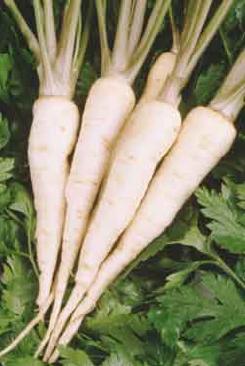
Parsley the herb needs no introduction; what may is the version of it that is grown not for its leaves but for its root, which is used in a culinary sense much like any other root, such as parsnips. Where once and for long only one seedsman that we know of carried it, suddenly one is seeing it everywhere (well, fairly commonly—when Ferry Morse has it, it’s hit the big time).
Globally, there are numerous cultivars of parsley root, which occupies a much more important position in European cuisine (especially middle European) than in American eating; we found references to types Arat, Atika, Bartowich Long, Berliner, Dobra, Eagle, Fakir, Halblange, Halblange Fakir, Halblange Perfekta, Halflange Omega, Hamburg, Hanácká, Jadran, Lange, Lange-glatte KP, Lange-glatte RZ, Olomoucká dlouhá, and Orbis. Of those, though, only a few are available in North America by cultivar name, and even of those some are of uncertain status owing to the seedsmen’s atrocious habit of being vague about variety names.
Named types that are definitely available in the U.S. include (alphabetically) Arat, Berliner (properly “Berliner Halblange”), Hamburg, Hilmar (aka Hilmer), and Polish; (“Hamburg” is often used as a generic name for this plant, only signifying the “rooted” non-herb sort, so offerings of “Hamburg” might be anything).
Currently, Arat seems all the rage. As their partisans say, “these roots are whoppers: they fill out well and grow almost a foot,”. But…in Europe, where these are a much-grown (and much-consumed) vegetable, so-called “half-long” (halblange) types, which are more stubby in shape, are preferred, as being easier to use in cooking and better-growing in heavy soils where longer, thinner types might fork. Of those reasonably available in the U.S., the half-long types are the Berliner and the Hilmar. Betwen this and that, we feel a mild preference for the type Hilmar; as one seedsman who grows and carries it said, [I]t’s very cold hardy – it was one of the crops that overwintered in the field during our record cold snap of December 2013 (lows of 5°F!). Good enough for us.
We feel we should here include this quotation from the WebMD site:
“Pregnancy: It is LIKELY SAFE to consume parsley in food amounts. But parsley in larger medicinal amounts is LIKELY UNSAFE to take during pregnancy. Parsley has been used to cause an abortion and to start menstrual flow. In addition, some research suggests that taking large doses of parsley with other herbs during the first three months of pregnancy can increase the risk of birth defects. If you are pregnant, stick with using only the amount of parsley typically found in food.”
Presumably that applies to the root as well.
Planting
Beware: parsley-root seeds are notoriously short-lived. If you aren’t saving you own seed annually, don’t try to be cheap and use last season’s leftovers—get fresh seed every year.
Seed Preparation
As with herb parsley seed, root parsley seed is rather fussy about germination. (Well, fussy to the grower: the plant “thinks” it’s very simple.) It requires “stratification”, which is a fancy term for treatment that makes the seed believe it has gone through a winter and that spring is now here. In this fine article, That Devilish Parsley, there is a good scientific discussion of germinating the seed. You really should read the entire article (which covers a deal more about parsley), but the highlight of the germination discussion is this:
Parsley contains chemicals called furamocoumarins in the seed coat. Because furanocoumarins prevent weed seeds from germinating, the home gardener won’t have to weed parsley quite as often as other plants. But there is a complication—the same furanocoumarins also may interfere with the germination of the parsley itself.
Soaking the seeds overnight will reduce to some extent the [otherwise] month-long germination period.
That “faking it” for the seeds is all rather tedious, and germination is still slow and often very spotty. An alternative method is winter sowing: direct-seed in late fall and let the seeds overwinter in the ground then come up when they’re jolly good and ready the next spring. The only drawback to this method is tying up the bed space for a long time—but if you grow it in a large container, well, that’s that.
Timing
Timing depends on whether or not you’re winter-sowing as described above. If so, timing is not critical, as you don’t expect the seeds to do anything till spring, so just sow them about as late as you can still work the soil. For more conventional direct seeding, we work back from a harvest date: these, like most root vegetables, are better after a light frost or three, and are cold-hardy, so we’ll target an anticipated harvest date at the end of October. The nominal days to maturity for Hilmar is 120, so we work back to a sowing date of July 3rd. And remember to pre-treat the seed before sowing, as described at the link given above.
The Bed
Parsley roots can tolerate any sort of soil, but—as we noted above—they, and all “roots”, do vastly better on soil that is very loose and friable, else they get stunted, show forked roots, and generally sit in their corners sucking lemons and sulking. For best results, dig your bed so as to loosen the soil as deeply as you can possibly manage, and remove all rocks and as many pebbles as possible, working in organic matter or even straight sand to make it good and loose. They like the more or less standard garden-soil pH of 6.5 to 6.8, or even a little lower, maybe 6.3. Rooted parsley can benefit from a little extra phosphate in the soil.
It is also wise to not use much manure in roots beds—and absolutely never any that is not thoroughly composted—or you’ll have forked roots galore. Parsley roots need good sun exposure. Like almost all roots, they are not frost-sensitive.
(It is wise to prepare one whole bed that way, for all your root crops—carrots, scorzonera, root parsley, and the like; in fact, you can do two beds that way, and alternate your root crops with anything else—for us, bush beans—that ought not to go in the same ground two years running.)
Planting Out
Even going with Mother Nature’s way, we think it wise to plant 2 or 3 seeds at each point where a plant is wanted, then see what emerges and thin—if necessary—to the most vigorous seedling when they look like they’re starting to compete. Parsley roots can be spaced at 4 inches, especially in a deep-dug or raised bed; some sources say 3 inches, but if you want good-sized roots, it’s best not to push the spacing too tight.
Easiest is to scatter the seed, then thin out as seedlingd pop up; you can’t save parsley-root seed, so use up the packet or whatever you bought.
(Some gardeners like to treat parsley-root seeds as carrot seeds are often treated: mix in a radish seed or two at every sowing spot, so the earlier, more aggressive radish seedling can break the surface for the carrot—or parsley—seedling, then pull the radish stem when the later root-crop seedling emerges; but we don’t like putting radishes, a crucifer, in any place that is not a part of that season’s crucifer beds in a rotation scheme.)
Growing
Parsley root, like parsley as such, requires moist soil. Because the chief part of the plant’s root system—the wanted root itself—lies relatively close to the surface, and the plant is a slow grower both above and below ground, its bed must be kept scrupulously clear of weeds, which would out-compete it for resources. But it is also needful to be correspondingly careful to cultivate shallowly and carefully, so as to not damage the crop’s own root system.
In summer’s heat, parsley root (and parsley) will want a little shade and a deal of water. A small, light framework with latticing to provide sun/shade strips that will move as the sun moves across the sky is a good idea and not much trouble to make. By starting them as late as we do, and considering their slow germination, we should be mostly past the peak-heat days of summer before the matter is an issue—but keep it in mind.
The leaves of the growing plant can occasionally be lightly picked over and used like herb parsley; opinion seems to vary widely on the flavor of rooted-parsley leaf vs. herb parsley, with some saying they’re inferior and other finding them just as good as the best herb types.
Leave the roots in the ground as late as possible—their flavor, as is typical of true root crops, is improved by their experiencing a frost. But do pull them after the first real frost, and don’t try to store them in the ground over winter.
(When you pull them is probably a good time to sow the seeds for the next year’s crop.)
More
Relevant Links
Besides any links presented above on this page, the following ought to be especially helpful.
Odds and Ends
Biology
Parsley is another of the highly useful crops in the Umbelliferae family, along with carrots, celery, celeriac, and a host of herbs—angelica, dill, chervil, herb parsley,
caraway, coriander, and others more obscure.
History
The ancestral wild parsley is thought to have arisen on the island of Sardinia. The Greeks and the Romans used parsley leaf much as we still do today. In mythology, parsley was believed to have sprung from a Greek hero, Archemorous, the forerunner of death; the Greeks crowned the winners at the Isthmian games with parsley, and warriors fed parsley leaves to their horses. Because parsley was considered as dedicated to Persephone (goddess of the underworld and afterlife) and thus to funeral rites, when Christianity supplanted the old beliefs parsley was consecrated to St. Peter, as the “successor” to Charon.
Parsley, long in common use all around the Mediterranean, was brought to England and apparently first cultivated there in 1548. Bentham considered it a native of the Eastern Mediterranean regions; De Candolle, of Turkey, Algeria, and the Lebanon. Since its introduction into the British islands in the sixteenth century, it has become naturalized there.
The ancients called two plants—celery and parsley (which are related)—by the general name selinon, but distinguished the two, calling celery heleioselinon, “marsh selinon”, and parsley oreoselinon (“mountain selinon”) or petroselinum, “rock selinon”. That last became, in the Middle Ages, corrupted to petrocilium, and was also variously anglicized as petersylinge, persele, persely, and parsley.
In the sixteenth century, Parsley was known as A. hortense, but herbalists retained the official name petroselinum. In 1764. Linnaeus classified it A. petroselinum.
No mention appears to have been made, either by the ancients or in the Middle Ages, of rooted parsley; but in 1771, Miller, in his Gardeners' Dictionary, referred to “largerooted Parsley”, saying: “This is now pretty commonly sold in the London markets, the roots being six times as large as the common Parsley. This sort was many years cultivated in Holland before the English gardeners could be prevailed upon to sow it. I brought the seeds of it from thence in 1727; but they refused to accept it, so that I cultivated it several years before it was known in the markets.”
Envoi
There are, it seems, an inordinate number of Superstitions About Parsley.
Return to the top of this page.
If you find this site interesting or useful, please link to it on your site by cutting and pasting this HTML:
The <a href="https://growingtaste.com/"><b>Growing Taste</b></a> Vegetable-Gardening Site
—Site Directory—
Search this site, or the web
-
Background Information
about the purposes and design of this site
- Site Front Page
-
Introduction
- An Apologia: why one should cultivate one's garden
- Deep-Bed Gardening (forthcoming)
- Container Gardening (forthcoming)
- Vegetarian and Organic Considerations (forthcoming)
-
Recommended Crops for a home garden, by variety
-
Gardening information and aids
-
Miscellaneous Information of interest to the home gardener
Since you're growing your own vegetables and fruits, shouldn't you be cooking them in the best way possible?
Visit The Induction Site to find out what that best way is!
|
If you like good-tasting food, perhaps you are interested in good-tasting wines as well?
Visit That Useful Wine Site for advice and recommendations for both novices and experts.
|

|
This site is one of The Owlcroft Company family of web sites. Please click on the link (or the owl)
to see a menu of our other diverse user-friendly, helpful sites.
|
|
 Like all our sites, this one is hosted at the highly regarded Pair Networks,
whom we strongly recommend. We invite you to click on the Pair link for more information on getting your site or sites hosted on a first-class service.
Like all our sites, this one is hosted at the highly regarded Pair Networks,
whom we strongly recommend. We invite you to click on the Pair link for more information on getting your site or sites hosted on a first-class service.
|
|
All Owlcroft systems run on Ubuntu Linux and we heartily recommend it to everyone—click on the link for more information.
|
Click here to send us email.
Because we believe in inter-operability, we have taken the trouble to assure that
this web page is 100% compliant with the World Wide Web Consortium's
XHTML Protocol v1.0 (Transitional).
You can click on the logo below to test this page!
You loaded this page on
Sunday, 6 April 2025, at 10:45 EDT.
It was last modified on Wednesday, 26 January 2022, at 17:34 EST.
All content copyright ©1999 - 2025 by
The Owlcroft Company