Owing to the screen size of your device, you may obtain a better viewing experience by
rotating your device a quarter-turn (to get the so-called "panorama" screen view).
|
This page updated for 2022.
|
Click here for the site directory.
|
|
Please consider linking to this site!
|
Click here to email us.
|
Radishes
(Raphanus sativus)
Cultivars
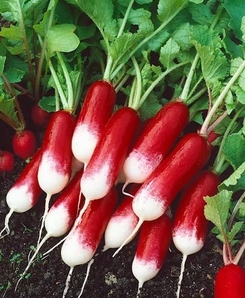
We had never eaten either winter radishes or radish seed pods (aka rat-tailed radish, and so tried both a while back (besides, of course, ordinary radishes). Neither sounded really exciting, but you never know until, so each got a trial. Our experience after trying winter radishes was that there is nothing notable about their flavor, and their texture was—to us—inferior, plus who can deal with so much radish at one time? We give up on those. Of the radish seed pods, we lazily let most get away till they were well past prime, and thus bitter, but the few we tried in salads and stir fries did not cause the Earth to move, and we give up on those too. If you want novelties, you can further research both types.
For common salad radishes, the choices are many, but the literature does not suggest any notable difference in eating quality. Perhaps the biggest difference is suitability for growing in the summer (radishes, like all Brassicas, being cool-weather crops). Ultimately, after inordinate amounts of time wasted on false trails and hybrids, we came to the conclusion that the well-known open-pollinated type French Breakfast is about the best heat-tolerant radish. Besides that, though, it is much recommended as a radish in general, so this one seems a no-brainer.
Note that though many seed houses offer seed just described as “French Breakfast”, there are actully several named cultivars of this type. The cultivar “D’Avignon” seems preferred. It is carried by numerous seedsmen.
(No, the French do not normally eat these with breakfast; they eat them as a snack, sometimes dipped in salt, sometimes lightly buttered and then dipped in salt, and sometimes sliced and served on a toasted, buttered baguette with a sprinkling of, yes, salt.)
French Breakfast radishes are not little round balls, as so many others are: they are somewhat elongated (see the image at the upper right), to about 2" to 4" long over a growth period of about four weeks. Mind, though, a radish being fairly heat-tolerant does not assure that it can happlly be grown throughout summer’s heat. As you are about to see, however, no loss.
It is no loss because we have come to the conclusion it’ss easier to grow our radishes indoors—they take up little space, we have some available in our indoor growing area, plus we can contain their soil and replace it periodically without clubroot fears. Thus, the hardiness of the type doesn’t enter into it, and we can choose freely. That said, though most types will obviously do ok in a container, the best choices will be the small globe types—the faster-growing, the better. If, within that class, there’s any advantage to one over another, we haven’t been able to discern it, and will stick with that fine French Breakfast type. Anyway, most of the following remarks apply equally to radishes grown in-ground or in containers.
Planting
Radishes are famously easy to grow, being often recommended as a first vegetable for children to try growing.
The one vital caution about radishes is the need to recall that they are, after all, Brassicas, and so if grown in-ground need either to be rotated on at least a four-year cycle or else grown in a small, isolated spot of their own. In summer they can go in amongst the various other Brassicas; but in winter—if one wants to grow them continuously—they need special treatment. We would grow them in a dedicated container, outdoors or indoors, and annually dump the soil out somewhere far from any growing areas; that may be overkill, but better safe than sorry for the ten years one has to wait out a clubroot infestation. The too-frequently given advice to intercrop radishes with non-Brassicas is likely pretty bad advice, though one source says they grow and are picked so quickly that clubroot doesn’t have a chance to develop; our philosophy is, again: better safe than sorry, especially when it’s so very easy to be safe.
Timing
If one is growing radishes year-round, one simply sows a little more seed for every few radishes pulled. If growing them outdoors, do the same thing anyway till, by not emerging, they tell you that it’s too cold for them. Start sowing again “as soon as the ground can be worked”, meaning when you’re not chipping ice to scratch the soil.
The Bed
Radishes prefer light, rich soil, but will usually grow in pretty much any garden soil.
If, as we do, you grow your radishes in a container, remember to discard and replace the soil at least annually, to avoid risk of clubfoot disease. Be sure that the discarded soil is truly discarded, quite some long way away from anywhere you are, or ever might in future be, growing Brassica vegetables.
Planting Out
Being fast-growing, radishes are invariably direct-seeded; being small, they are invariably planted out densely, typically at a 2-inch spacing; being wanted constantly, they are normally succession-sown, on whatever basis is comfortable for the gardener (from daily to weekly). Being conservative, we’d use a 3" spacing.
Plant the seed about ½ inch deep. Radishes are not frost-tender; if you have a sunny, protected spot you might be able to get them through most of the winter (but don’t put them in your protected lettuce bed, if you have such, for the reasons noted above).
Growing
Seedlings usually emerge in a mere 3 to 4 days.
Water your radishes well and frequently—lest they become pithy or over-hot in taste—wait 3 weeks or so, then pull; their maturity is listed as typically 25 days or so, and most sources say “3 to 4 weeks”, though that may be a significant understatement (4 to even 6 weeks might be more accurate). But if you’re succession cropping, you might as well pull them fairly early, to avoid unwanted bitterness (the chief bane of radishes).
In summer (when the temperatures are over, say, 80° or so) providing some shade is a good idea.
Radishes grown for their edible pod (special types, usually called “rat-tail”) need to be harvested quite young, else the seed pods turn very bitter.
More
Relevant Links
Besides any links presented above on this page, the following ought to be especially helpful.
Odds and Ends
Biology
Radishes are, of course, of the Cruciferae, the cole crops, as are most slightly bitter hot-tasting vegetables. Ordinary garden radishes are Raphanus sativus, but the “rat-tail” sort are R. sativus caudatus (and their “radish” root is not very good eating—they are grown only for the seed pod); “Oriental” or “winter” radishes are R. sativus niger. There is also a race R. sativus oleiformis, the “fodder” radishes, which are grown mostly for their leaves and oil-rich seeds and as a green manure or stock feed (though they can, in principle, also be eaten by people).
Garden radishes have some close cousins: R. landra, a wild radish; R. maritima, the “sea radish”, a wild radish found in sea-coast areas and somewhat horse-radishy; and R. raphanistrum, the “wild radish”. All those types have edible qualities, but not for the familiar root: the young leaves are a rustic potherb.
History
Radishes, mentioned by Kung Fu Tze (Confucius) as early as 479 B.C., probably originated in China, but are so ancient that their original ancestor is not known for sure. The Egyptians used radish-seed oil as we today use olive oil (which was then unknown). The ancient Greeks consumed radishes, and even included them in their sacrifices to the gods, carrying the radishes on gold platters. Pliny the Roman, however, remarked that the radish is “a vulgar article of the diet…” with a “.…remarkable power of causing flatulence and eructation.”
Envoi
In Oaxaca, Mexico, on December 23rd artists carve long radishes into elaborate sculptures, typically of animals, for La Noche de los Rabanos—The Night of the Radishes.
Return to the top of this page.
If you find this site interesting or useful, please link to it on your site by cutting and pasting this HTML:
The <a href="https://growingtaste.com/"><b>Growing Taste</b></a> Vegetable-Gardening Site
—Site Directory—
Search this site, or the web
-
Background Information
about the purposes and design of this site
- Site Front Page
-
Introduction
- An Apologia: why one should cultivate one's garden
- Deep-Bed Gardening (forthcoming)
- Container Gardening (forthcoming)
- Vegetarian and Organic Considerations (forthcoming)
-
Recommended Crops for a home garden, by variety
-
Gardening information and aids
-
Miscellaneous Information of interest to the home gardener
Since you're growing your own vegetables and fruits, shouldn't you be cooking them in the best way possible?
Visit The Induction Site to find out what that best way is!
|
If you like good-tasting food, perhaps you are interested in good-tasting wines as well?
Visit That Useful Wine Site for advice and recommendations for both novices and experts.
|

|
This site is one of The Owlcroft Company family of web sites. Please click on the link (or the owl)
to see a menu of our other diverse user-friendly, helpful sites.
|
|
 Like all our sites, this one is hosted at the highly regarded Pair Networks,
whom we strongly recommend. We invite you to click on the Pair link for more information on getting your site or sites hosted on a first-class service.
Like all our sites, this one is hosted at the highly regarded Pair Networks,
whom we strongly recommend. We invite you to click on the Pair link for more information on getting your site or sites hosted on a first-class service.
|
|
All Owlcroft systems run on Ubuntu Linux and we heartily recommend it to everyone—click on the link for more information.
|
Click here to send us email.
Because we believe in inter-operability, we have taken the trouble to assure that
this web page is 100% compliant with the World Wide Web Consortium's
XHTML Protocol v1.0 (Transitional).
You can click on the logo below to test this page!
You loaded this page on
Saturday, 27 April 2024, at 00:36 EDT.
It was last modified on Wednesday, 5 January 2022, at 03:37 EST.
All content copyright ©1999 - 2024 by
The Owlcroft Company