Owing to the screen size of your device, you may obtain a better viewing experience by
rotating your device a quarter-turn (to get the so-called "panorama" screen view).
|
This page updated for 2022.
|
Click here for the site directory.
|
|
Please consider linking to this site!
|
Click here to email us.
|
Tomatillos
(Physalis ixocarpa)
Cultivars
Sorting Out Types
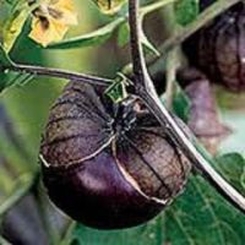
This little delight, far better known in Latin America (where it is a literally essential ingredient of what Gringos call “salsa”), is the subject of much gross misunderstanding in North America. It is continually being confounded with its close and not-so-close relatives (described below); we once, back in California, ordered some “tomatillo” seeds which, when we finally harvested the crop, we discovered to have been Cape gooseberry—possibly useful in desserts, but comically useless for salsa.
For the record, the various Physalis species are:
P. ixocarpa is the true tomatillo.
P. philadelphica is the Tarahumara, Tepehuan, and Zuni tomatillos—smaller, wild, semi-cultivated types.
P. pruinosa includes the ground cherry, the husk tomato, the strawberry tomato, and the dwarf Cape gooseberry.
P. peruviana includes the Cape Gooseberry, Husk Tomato, Goldenberry, Poha, Ground Cherry, Gooseberry Tomato, and Ground Cherry.
P. heterophylla is the downy ground cherry, or clammy ground cherry.
P. franchetii is the familiar decorative Chinese/Japanese Lantern plant, also known as Winter Cherry or Strawberry Tomato.
You should know, however, that even expert plant scientists working with these types disagree on some of the categorizations; the taxonomy is far from settled. (We have seen more than one seedsman asserting that P. philadelphica is a synonym of P. ixocarpa: caveat emptor.)
So if you grow this crop—and we think everyone should—be sure you’re getting true Physalis ixocarpa and nothing else.
Viability
We were pleasantly surprised to find that this useful and pleasing vegetable, despite our associating it with tropical climates, is also robust in cool weather (indeed, it seems to be remarkably robust relative to almost everything except actual frost). One home gardener has written—
“I trialed six different kinds last summer and each bore at least 15 pounds of fruit, in a drought no less. For a plant native to Central and South America, tomatillos are remarkably easy to grow in cooler climes, as my zone 6A garden attests. One gardener to whom I gave seeds had fine luck with them on the prairies of central Saskatchewan, three zones north of me. If tomatillos weren’t frost-tender, they’d take over the surface of the planet.”
From our experience, we concur: we got what seemed like tons of the things from two plants—picking them all was a massive task.
Selecting Varieties
Although growers have made sporadic attempts to improve the tomatillo by selection, little has been accomplished, and the tomatillo remains a crop with great variability in plant habit, fruit size, earliness, and other characteristics. The one thing of significance often said about tomatillo varieties is that the purple ones have better taste than the green types. We suspect, from our research, that many of at least the purple types are possibly pretty much the same actual variety, albeit perhaps with some modest landrace differences. At any rate, we could find no substantive basis for distinguishing any one supposedly “named” purple variety from another, and so recommend any Physalis ixocarpa tomatillo clearly labelled as a Purple Tomatillo.
Most seed houses purple offerings are just labelled “Purple Tomatillo”; whether that’s to be taken as an actual variety name is hard to say, but we doubt it—it’s likely just a descriptor. The actually named purple types we saw include (in no special order) Purple de Milpa, Purple Coban, Purple Keepers, Purple Blush, and Morado, and there may be others. Ya pays yer money an’ ya takes yer chances.
The Pollination Issue
There is much argument over whether tomatillo plants are or are not self-pollinating. It is common to read that they are not, and that at least two plants are necessary for pollination to get fruit. But others assert that tomatillo flowers are “perfect”—a term meaning that they are both male and female. That appears to be true; but it remains so that many attempting tomatillos as single plants report lush blossoms but no fruit set. Now it must be noted that tomatillos notoriously bush out hugely early on, but actually set fruit all in a rush right near the end of their season, so at least some of those reporting difficulties may simply have been impatient (“Look at that Tomatillo Pollination thread again and notice the date of each post. The folks who talk about no fruit are posting in July and early August. At least one of those came back later to report an abundance of fruit.”). Others say that sometimes one has to help the plant along: “[L]ike some self-fertile plants, tomatillos may require agitation to transfer the pollen effectively…whether by insects, wind, thumping the flowers lightly, or giving the plant a good quick shake in the morning.”
While these things do eat space (a 2' x 2' space per plant is barely adequate), it nonetheless seems the safe thing to do is to plant at least two. Mind, unless you’re running a salsa factory, the output of two plants is likely all you’ll ever need.)
Planting
The tomatillo has about the same needs as the tomato, and can be grown in about the same way (though it is hardier than the tomato). Note that several places offer potted transplants of tomatillos, which is the easy way to get started.
Timing
“Days to maturity” quotations given by seedsmen are all over the lot on these. For the same type, one can find, for example, quotations ranging from 70 days to 120 days. A test done by Purdue University showed all types they tested coming in at 55 to 60 days “to flower”; that may not indicate true days to full fruit set, but it does seem to say that no tomatillo type grows all that differently from any other.
Advice as to a transplant date is also all over the lot, but most commonly says you need to wait for it to get really warm—which ignores tomatillo’s famed cold-hardiness. One source, for example, said “nighttime temperatures should be 55 degrees Fahrenheit or higher”. What a joke! In our climate, we never have an average nighttime low as high as that (we peak out at about 50°), yet we grew extravagantly successful tomatillos. The best advice seems to be to just wait till all reasonable likelihood of frost has passed, then get ’em in. In our climate, that last-frost date would be early to middle May, but for safety’s sake we do as for tomatoes and other warm-weather crops and use June 1st.
Starting Seedlings
Sow seed indoors, in good-sized peat or cow pots, say 4 inches. Keep the pots as warm as you can (preferably with heating pads) till emergence, their ideal germinating temperature being in the middle to upper 80s. Allow about 7 weeks for indoor growth time, which means sowing April 13th or thereabouts. (But, as we said above, buying transplants saves a lot of effort.)
The Bed
Prepare their bed by deep digging, addition of organic material, and—as tests may show necessary—amendment with organic fertilizers. Tomatillos do best in a rich, loamy soil, though they’re amazingly tolerant (growing virtually as weeds in their native climate). A standard garden-soil pH of 6.5 to 6.8 works fine, but they can do well enough in anything from 6.0 to 7.0. Basically, their needs are like those of tomatoes.
It is wise to use plastic mulch, preferably red, and to set that mulch out a couple of weeks before transplant time to get the soil warmed. Plastic mulch also suggests drip irrigation, which is always a good thing; and row cover is advantageous as well in our climate.
Transplanting Out
Possibly because of the notorious variability of tomatillo plants, there seems wide disagreement about a good inter-plant spacing for them: the range offered runs from 15 to 24 to even 36 inches. On the one hand, one wants them as close as practicable, to conserve garden space and to encourage the necessary cross-pollination; on the other hand, one doesn’t want the plants competing for sun and space. We used 24 inches and were glad we did—they bushed out hugely.
All advice says to be careful to harden the plants off for a few days before actual transplant (we include the hardening-off days in the 7 weeks of seedling growth). Whatever you do, though they’re fairly hardy, do not expose them to risk of actual frost.
Plastic mulch (applied a couple of weeks before your expected transplant date), row cover, and drip irrigation—the usual warm-weather-crop adjuncts—are all advisable. So too are cages (real tomato cages—see the article here on tomatoes—not those wimpy little conical frames they sell in stores).
Growing
The tomatillo is a low-growing, sprawling bush plant, usually not more than 2 feet high. That can make two things awkward: watering and weeding. For watering, drip irrigation is an easy and inexpensive answer. As to weeding, use of plastic mulch renders the question moot. Water well, as for tomatoes.
If you used row cover, get it off as soon as temperatures allow, so the plants can be pollinated by bees; if you don’t seem to have bees in your garden, take care to hand-pollinate your tomatillos. Recall again that the plants don’t like actual freezes, but are otherwise pretty temperature-hardy.
If, as it grows, a plant is spreading too much (which caging minimizes), you can pinch off the more aggressive branch’s tips.
Time to maturity is reported differently by different sources, ranging from “first harvest is generally 70 to 80 [days] from seeding” to “mature fruit are produced in about 120 days.” That may not be as contradictory as it sounds, for commercial harvest is often of fruit not fully mature. Tomatillo fruits need to be hand-selected and harvested daily as the plant approaches maturity: tomatillos are not fully ripe till the fruit begins to break through the husk. (The husks split, but don’t fall off, as the fruits mature.)
If you want to pick earlier than at full maturity, select fruits about 1¼ inches in diameter; by harvesting before full maturity, you can spread the harvest period out over perhaps two months. Commercial growers try to harvest when the fruits are well-formed and have substantially filled the husk, but are still bright in color (overmature fruit are light in color or yellowish, and it is said that those should be avoided as being sweeter and thus undesirable for most standard tomatillo uses). The purple varieties are said to grow significantly smaller fruits, but they grow more and so produce about the same net weight per plant—but use your head with respect to picking sizes, depending on the type you’re growing.
More
Relevant Links
Besides any links presented above on this page, the following ought to be especially helpful.
Odds and Ends
Biology
Tomatillos are members of the prodigiously useful Solanaceae (or nightshade) family, as are tomatoes, peppers, tomatillos, and eggplants, among others. Some botanists unite this species with P. philadelphica, saying that it arose from P. philadelphica through cultivation (probably true, but possibly irrelevant).
History
The tomatillo is native to Central America, and was used by the Aztecs in pre-Columbian times. In fact, there is archaeological evidence of its use as a food in the valley of Tehuacán in the centuries from 900 B.C. to A.D. 1540. Before the European arrival, the tomatillo was used far more than the tomato, but eventually the latter came to dominate, except in some rural areas where the tomatillo is still preferred over the tomato.
The ancestral wild tomatillo was domesticated in Mexico, then carried back by the Europeans on their arrival in the New World. It enjoyed some popularity till being eclipsed by the tomato.
Envoi
How long has the tomatillo been around? At least 52 million years.
Return to the top of this page.
If you find this site interesting or useful, please link to it on your site by cutting and pasting this HTML:
The <a href="https://growingtaste.com/"><b>Growing Taste</b></a> Vegetable-Gardening Site
—Site Directory—
Search this site, or the web
-
Background Information
about the purposes and design of this site
- Site Front Page
-
Introduction
- An Apologia: why one should cultivate one's garden
- Deep-Bed Gardening (forthcoming)
- Container Gardening (forthcoming)
- Vegetarian and Organic Considerations (forthcoming)
-
Recommended Crops for a home garden, by variety
-
Gardening information and aids
-
Miscellaneous Information of interest to the home gardener
Since you're growing your own vegetables and fruits, shouldn't you be cooking them in the best way possible?
Visit The Induction Site to find out what that best way is!
|
If you like good-tasting food, perhaps you are interested in good-tasting wines as well?
Visit That Useful Wine Site for advice and recommendations for both novices and experts.
|

|
This site is one of The Owlcroft Company family of web sites. Please click on the link (or the owl)
to see a menu of our other diverse user-friendly, helpful sites.
|
|
 Like all our sites, this one is hosted at the highly regarded Pair Networks,
whom we strongly recommend. We invite you to click on the Pair link for more information on getting your site or sites hosted on a first-class service.
Like all our sites, this one is hosted at the highly regarded Pair Networks,
whom we strongly recommend. We invite you to click on the Pair link for more information on getting your site or sites hosted on a first-class service.
|
|
All Owlcroft systems run on Ubuntu Linux and we heartily recommend it to everyone—click on the link for more information.
|
Click here to send us email.
Because we believe in inter-operability, we have taken the trouble to assure that
this web page is 100% compliant with the World Wide Web Consortium's
XHTML Protocol v1.0 (Transitional).
You can click on the logo below to test this page!
You loaded this page on
Thursday, 17 April 2025, at 20:58 EDT.
It was last modified on Thursday, 6 January 2022, at 21:10 EST.
All content copyright ©1999 - 2025 by
The Owlcroft Company