Owing to the screen size of your device, you may obtain a better viewing experience by
rotating your device a quarter-turn (to get the so-called "panorama" screen view).
|
This page updated for 2022.
|
Click here for the site directory.
|
|
Please consider linking to this site!
|
Click here to email us.
|
Chervil Root
(Chaerophyllum bulbosum)
Cultivars

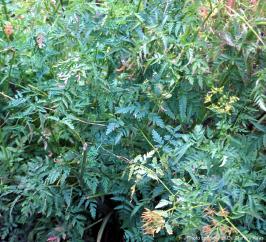
Chervil the herb should need no introduction; what may is the version of it that is grown not for its leaves but for its root, which is used in a culinary sense much like any other root. This is now a little-known vegetable—though once, long ago, it was popular. Nowadays, a fair number of seedsmen carry it, but none we’ve seen offer any sort of named variety: it’s just “turnip-rooted chervil” or something like. Buy seed from your favorite seedsman who carries it (not so many do).
Its flavor is said (we haven’t yet tried it) to be a sort of cross between carrots and chestnuts—“floury and sweet, with a peculiar aromatic flavor” says the old Vilmorin vegetable guide (most other sources—though possibly just copying one another—also mention chestnuts and a “floury” composition, whatever that is). The shape of the root (see the image above left) is stubby and bulbous, rather than the parsnippy elongated look common to most root vegetables.
(This is not the only herb with a distinct form bred for its root—there is also, for example, rooted parsley.)
If you want to try some of this charming root, have a care with it. Its cousin, herb chervil (related, but not closely) can easily become highly invasive [archived copy]; whether that is also true of this plant is uncertain, but, as we say, have a care with it. (Note that the invasive species spreads by both seed and underground runner, and so is almost impossible to eradicate once established.) For that and other logistic reasons, it is probably best grown (like scorzonera) in a large container, which you harvest by just tipping the whole thing over onto a sheet of tarp and taking the tubers out of the resultant soil pile.
Planting
Beware: chervil-root seeds are very short-lived! If you aren’t saving you own seed annually, don’t try to be cheap and use last season’s leftovers—get fresh seed every year. In fact, their seeds lose their vitality in a dry seed packet so rapidly that if you can’t plant them or begin stratifying them as soon as you get them, at least store them covered in cool slightly damp sand.
Growing them may seem tricky, but it really isn’t—in fact, the plant is now becoming a serious weed problem in the northeast, so readily does it grow in a northern climate. The “trick”, if there is such a thing, as mentioned above, is to dedicate a moderate-sized lightweight container solely to them (we use a cheap plastic hardware-store “laundry basket”with drainage holes drilled in the bottom). Fill it with friable soil—mix some sand in if necessary.
Timing
Rooted chervil requires two things to succeed: a “stratification” period of at least two months, and properly timed planting. One U.K. seed house summmed it up pithily:
Growing this delicacy is not easy. Root chervil needs frost to germinate and should be sown in the autumn of the previous year. Since chervil root seeds are only germinable for approximately one year, it is almost mandatory to sow the seeds directly after [obtaining] them.
“Stratification” means exposure to cold and damp—exposing the seed to near-freezing temperatures in a humid environment for a period of 8 to 10 weeks; one source referred to a temperature range of 32° F to 43° F, while another just mentioned a temperature of 39° F. You can thus stratify seed (as with parsley) indoors in a refrigerator.
But…since the idea is to emulate the seed’s spending winter in the ground, the easiest way to stratify is—duh—to actually let the seed spend a winter in the ground. In the following year, the roots will finish growing sometime in, probably, July or so—but (like almost all root crops) it benefits much from some frost, which converts starches to sugars. And once the roots are fully grown, they can sit in the ground till that ground freezes hard. So, we plant the tubers in middle to late autumn, after the first light frosts but before the ground gets frozen. If we want to be more exact, let’s say mid-October. We then just water and perhaps cultivate, but largely leave the things alone till the next year at the same time, when we harvest and then immediately replant.
The “Bed”
Chervil roots can tolerate any sort of soil save really bad clay, but—as we noted above—they, and all “roots”, do vastly better on soil that is very loose and friable, else they get stunted, show forked roots, and generally sit in their corners sucking lemons and sulking. For best results, loosen the soil as deeply as you can possibly manage; if you use a container, as we recommend, the annual dumping for harvest automatically assures looseness in the soil. If needful, work in some organic matter or even straight sand to make that soil good and loose. The roots like the more or less standard garden-soil pH of 6.5 to 6.8, or even a little lower, maybe 6.3. Rooted chervil can benefit from a little extra phosphate in the soil.
It is also wise to not use manure in any “roots” bed—and absolutely never any that is not thoroughly composted—or you’ll have forked roots galore (that is true for almost all root vegetables). Chervil roots need good sun exposure. Also like almost all roots, they are not frost-sensitive.
Planting Out
Chervil-root seeds can have a low germination rate even under optimum conditions; it is wise to plant 2 or 3 seeds at each point where a plant is wanted, then see what emerges and thin—if necessary—to the most vigorous seedling when they look like they’re starting to compete. Chervil roots can probably be spaced at 2 to 3 inches, especially in a deep-dug or raised bed, or a container.
Plant the seeds very shallow—indeed, you might just place them on the surface and sift a tiny bit of soil or sand over them to keep them from blowing away. And be sure to keep their soil moist, especially till emergence.
Growing
Chervil root, like chervil as such, requires moist soil. When the seedlings are young and small, cultivate well but carefully and not too deep.
In summer’s heat, chervil root (and chervil) might want a little shade. A small, light framework with latticing to provide sun/shade strips that will move as the sun moves across the sky is a good idea and not much trouble to make. Or, if you are growing them in a tub or tubs, put the container on the east or west side of the house, to reduce their sun hours.
Again: the root is considered edible only after it has been exposed to at least one strong freeze, and preferably a couple. So leave the roots in the ground as late as possible, till the ground is ready to freeze solid. Oh, and when preparing them, don’t peel them: the skin adds to the flavor (and contains much of the not insubstantial nutrative content of the vegetable.
More
Relevant Links
Besides any links presented above on this page, the following ought to be especially helpful:
Odds and Ends
Biology
Chervil is another of the highly useful crops in the Umbelliferae family, along with parsley root, carrots, celery, celeriac, and a host of herbs—angelica, dill, herb chervil, caraway, coriander, and others more obscure.
History
Turnip-rooted chervil was enjoyed by the early Greeks and Romans, and in England during the 14th to 17th centuries. It was introduced into France in 1846, and over the last 20 years, much work on developing the plant for better modern use has taken place there.
Envoi
This is a vegetable that not a few think is due and long overdue for a renaissance.
Return to the top of this page.
If you find this site interesting or useful, please link to it on your site by cutting and pasting this HTML:
The <a href="https://growingtaste.com/"><b>Growing Taste</b></a> Vegetable-Gardening Site
—Site Directory—
Search this site, or the web
-
Background Information
about the purposes and design of this site
- Site Front Page
-
Introduction
- An Apologia: why one should cultivate one's garden
- Deep-Bed Gardening (forthcoming)
- Container Gardening (forthcoming)
- Vegetarian and Organic Considerations (forthcoming)
-
Recommended Crops for a home garden, by variety
-
Gardening information and aids
-
Miscellaneous Information of interest to the home gardener
Since you're growing your own vegetables and fruits, shouldn't you be cooking them in the best way possible?
Visit The Induction Site to find out what that best way is!
|
If you like good-tasting food, perhaps you are interested in good-tasting wines as well?
Visit That Useful Wine Site for advice and recommendations for both novices and experts.
|

|
This site is one of The Owlcroft Company family of web sites. Please click on the link (or the owl)
to see a menu of our other diverse user-friendly, helpful sites.
|
|
 Like all our sites, this one is hosted at the highly regarded Pair Networks,
whom we strongly recommend. We invite you to click on the Pair link for more information on getting your site or sites hosted on a first-class service.
Like all our sites, this one is hosted at the highly regarded Pair Networks,
whom we strongly recommend. We invite you to click on the Pair link for more information on getting your site or sites hosted on a first-class service.
|
|
All Owlcroft systems run on Ubuntu Linux and we heartily recommend it to everyone—click on the link for more information.
|
Click here to send us email.
Because we believe in inter-operability, we have taken the trouble to assure that
this web page is 100% compliant with the World Wide Web Consortium's
XHTML Protocol v1.0 (Transitional).
You can click on the logo below to test this page!
You loaded this page on
Tuesday, 15 April 2025, at 03:31 EDT.
It was last modified on Monday, 3 January 2022, at 03:43 EST.
All content copyright ©1999 - 2025 by
The Owlcroft Company